Custard
https://kitchenprojects.substack.com/p/kitchen-project-148-plant-based-custard
Can be made up to 5 days in advance and stored in the fridge.
Yield: about 440 g (2 cups)
Total time: 10 minutes, plus cooling
Ingredients
- 66 g raw cashews (slightly rounded 1/2 cup)
- 35 g peeled carrot (about a 1-inch piece)
- 63 g sugar (5 Tbsp)
- 13 g cornstarch (UK: “cornflour”) (1 Tbsp + 2 1/2 tsp)
- 1/2 vanilla bean (no need to split or scrape)
- Pinch salt
- 250 g water (1 cup + 2 tsp)
- 20 g extra virgin olive oil (1 Tbsp + 2 tsp; See Note)
- 1/4 tsp apple cider vinegar
Method
- In a high-powered blender, combine the cashews, carrot, sugar, cornstarch, vanilla bean, salt, and water. Blend until perfectly smooth, then pass the liquid through a fine-mesh sieve into a small-medium saucepan (discard the filtered solids).
- Whisk in the olive oil and vinegar and cook over medium heat, whisking constantly, just until about 30 seconds after it begins to bubble. It should be thick, creamy, and pudding-like, somewhere between the texture of unstrained and strained yogurt.
- Scrape it into a storage container and place a piece of parchment directly on top of the cream to prevent a skin from developing. Cover with a lid and refrigerate the cream until ready to use (up to 5 days).
Buns
https://kitchenprojects.substack.com/p/e62734c0-fdbc-4032-b200-b033c28da784
Yield: 16 buns
Active Time: 50 minutes
Rising Time: 2 to 4 hours
Total Time: 2 hours 50 minutes to 4 hours 50 minutes
Ingredients
For the oat-cashew cream:
- 45g rolled oats
- 35g raw cashews
- 260 g water
- 20g bread (UK: “strong”) flour
For the tangzhong:
- 180 g “oat-cashew cream” (half of the yield from above; about 3/4 cup)
For the dough:
- 180 g “oat-cashew cream” (the remaining half of the yield from above; about 3/4 cup)
- 1 tsp apple cider vinegar (5 g)
- 80 g sugar (6 Tbsp), plus more for filling
- 9 g active dry yeast (1 Tbsp; or 33 g fresh yeast)
- 405 g bread (UK: “strong”) flour (3 1/4 cups + 2 Tbsp)
- all tangzhong yielded from above, cooled to 46ºC (115ºF) or below
- 8 g salt (1 1/2 tsp)
- 65 g extra virgin olive oil (1/3 cup), plus more for filling
For the syrup:
- 100 g sugar (1/2 cup)
- 120 g water (1/2 cup)
- 1/2 vanilla bean
Method
- Make the oat-cashew cream: Blitz the oats, cashews, water, and 20 g flour in a high-powered blender until very smooth. Pass the resulting liquid through a fine-mesh sieve and discard any solids.
- Make the tangzhong: Pour half of the oat-cashew cream (180 g, or about 3/4 cup) into a small-medium saucepan. Heat it over medium heat, whisking constantly and making sure to scrape the bottom of the pan with the whisk to avoid burning, just until it has thickened to the consistency of a loose porridge (this will take only minutes). Turn off the heat and set aside to cool.
- Mix and autolyse: Pour the remaining 180 g (3/4 cup) oat-cashew cream into a stand mixer bowl. Whisk in the vinegar, sugar, and yeast. Heap the flour on top of the yeasted liquid, followed by the slightly cooled tangzhong. Using a stand mixer affixed with a dough hook, mix the dough on the lowest speed just until it comes together as a mass and no scraps remain on the wall of the bowl, about 2 minutes. Stop the mixer, cover the bowl with a kitchen towel, and let rest for ten minutes. (This rest, or autolyse, stage gives the flour time to hydrate and the gluten in it time to develop.)
- Knead, incorporating salt and oil: Remove the kitchen towel, start a 15-minute timer, and turn the mixer on to its lowest speed. Sprinkle the salt over the dough. Over the course of a few minutes, gradually add the oil in a thin stream. Once you’ve added all of the oil, increase the speed to the second-lowest setting and continue to knead the dough. Pause to scrape down the sides of the bowl and to push the dough down as necessary. Once the timer goes off, stop the mixer and check the condition of the dough. If it isn’t silky-smooth, continue to knead for up to another five minutes.
- First rise: Remove the dough hook and shape the dough into a smooth ball between your hands. Cover the bowl (with a silicone bowl cover, a damp kitchen towel, or aluminum foil) and let rest in a warm spot until the dough has nearly doubled in volume and is soft enough for a deep indent to remain when you poke it, 60 to 90 minutes. (The warmer the room, the faster the rise. It was about 65°F / 18°C in my house on the winter day when I made the dough, and I gave it the full 90 minutes.)
- Make the syrup while the dough mixes or rises: In a small saucepan, whisk the sugar with the water. Split the vanilla bean lengthwise, scrape the seeds out, and add both seeds and pod to the saucepan. Heat over medium heat until all of the sugar has completely dissolved and the liquid is clear. Set aside.
- Roll, fill, shape: Line a half-sheet pan with parchment.Roll the dough out to a rectangle, dusting your rolling surface with flour only if necessary, about 30 cm (11.5 in.) wide, 50 cm (19.5 in.) long, 5 mm (3/16 in.) thick. (If at this point the dough feels tense and resists rolling, give it 5 to 10 minutes to relax and it will be easier to work with.) Use a pastry brush to apply a thin layer of olive oil—about 2 tablespoons in total—to the entire surface of the dough. Sprinkle the oiled dough with sugar—preferable vanilla sugar, if you have it—about 15 grams in total. Fold the bottom third over onto the filling, then fold the top third down over that, as you would fold a letter (I hope some of at least have folded a letter!). Press the folded dough down with your hands, then use a rolling pin to stretch it out to a rectangle that’s about 34 cm (13 in.) wide by 23 cm (9 in.) long.
- With a pizza cutter, knife, or bench scraper, mark the midpoint of the dough’s width. Then mark the midpoint of each half and continue to mark the midpoints twice more, until you have marked 16 segments of dough. Follow the marks to cut 16 equal strips of dough, each about 1.5 cm (5/8 in.) wide. Stretch the strips so that they’re about 30 cm (12 in.) long. Turn one of the dough strips onto its side and roll it into a spiral—not tight, as you want to give it room to expand—and tuck the end under the bottom. Place on the lined sheet pan. Repeat with the remaining strips of dough, arranging the rolls with enough space between to allow each to double in size. Gently press on the rolls with your fingers to flatten them just a bit.
- Final rise, crater add cream, bake: Cover the sheet pans (with an inverted sheet pan, or parchment plus a towel), and allow the buns to rise in a warm place for 1 to 2 hours, until they’ve grown very puffy and feel soft and light when you poke them with a finger. Preheat the oven to 200c fan/ 220 / 400ºF convection/fan (or 425º if you don’t have convection/fan).
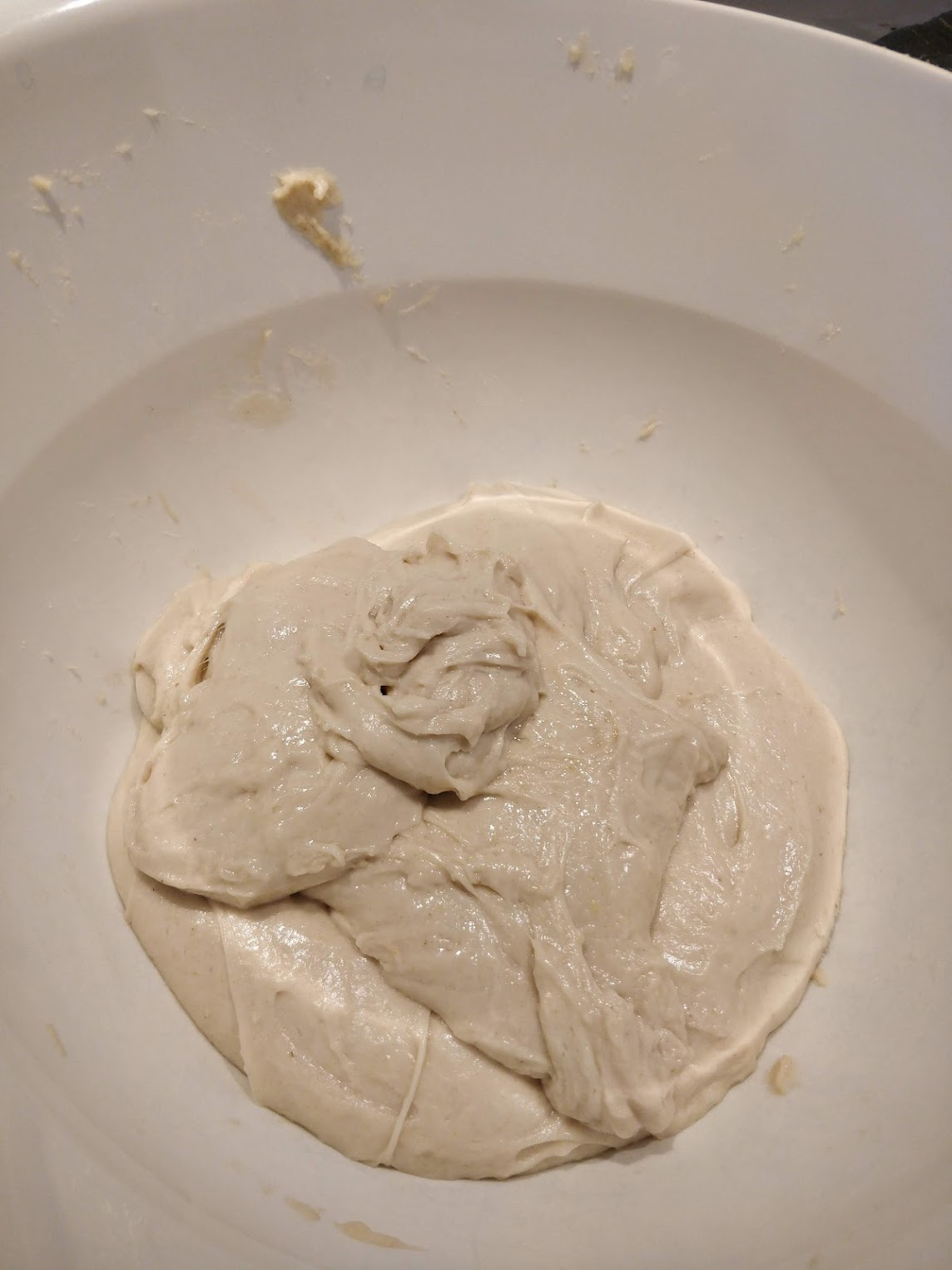 Dough before rising.
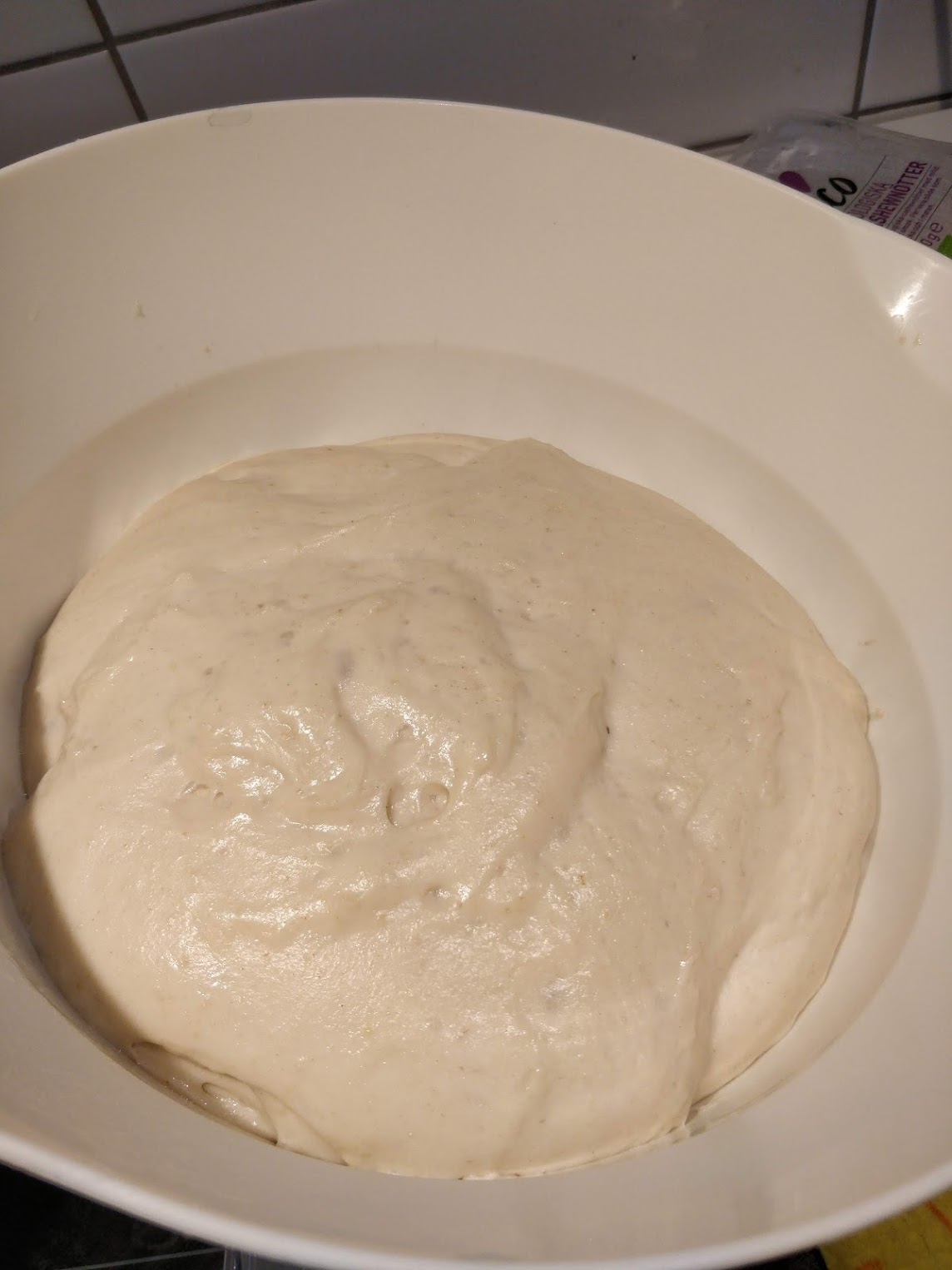 Dough after rising.
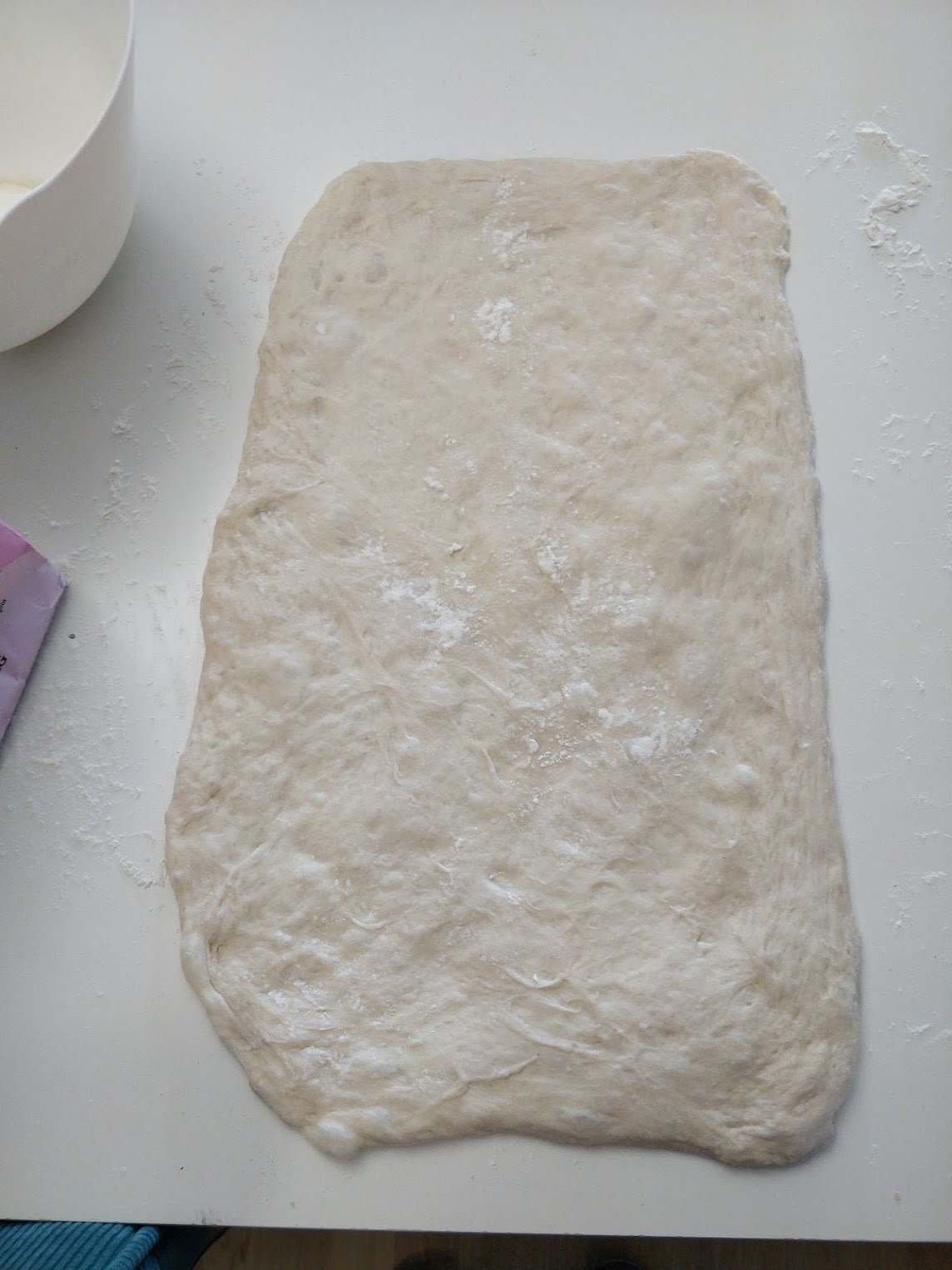 Rolled-out rectangle.
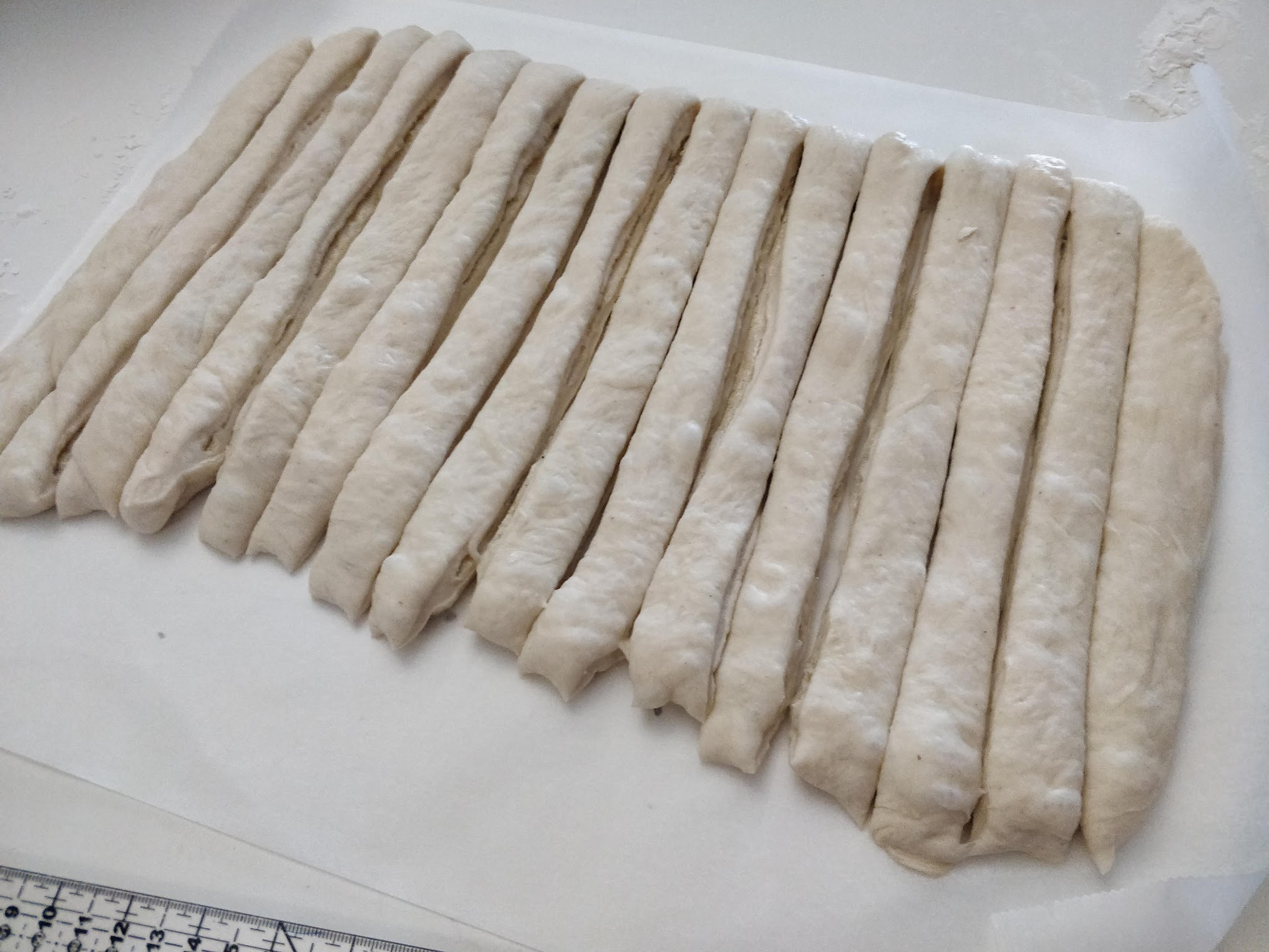 Cut in strips.
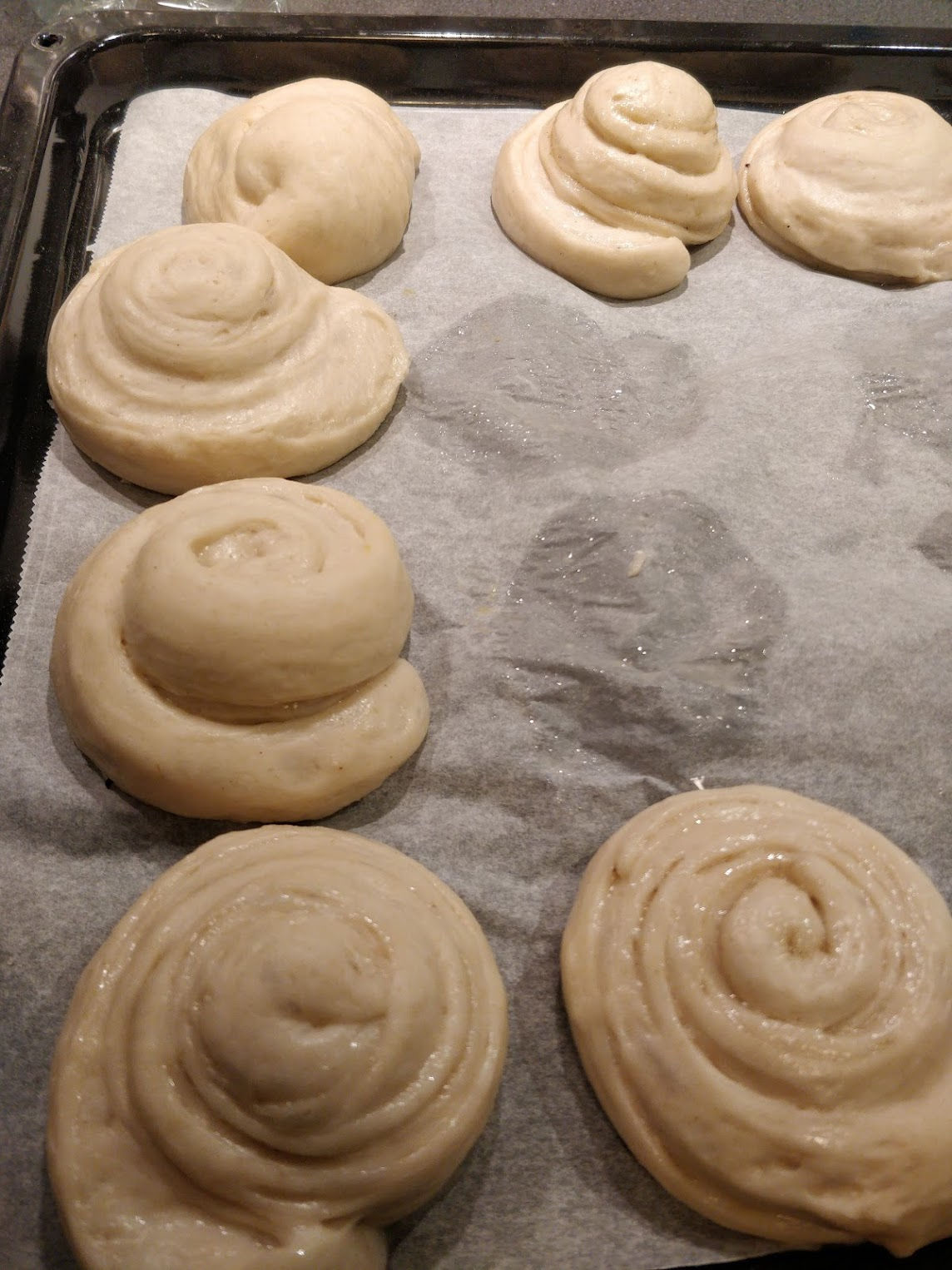 Rolled into little swirls and let rest again.
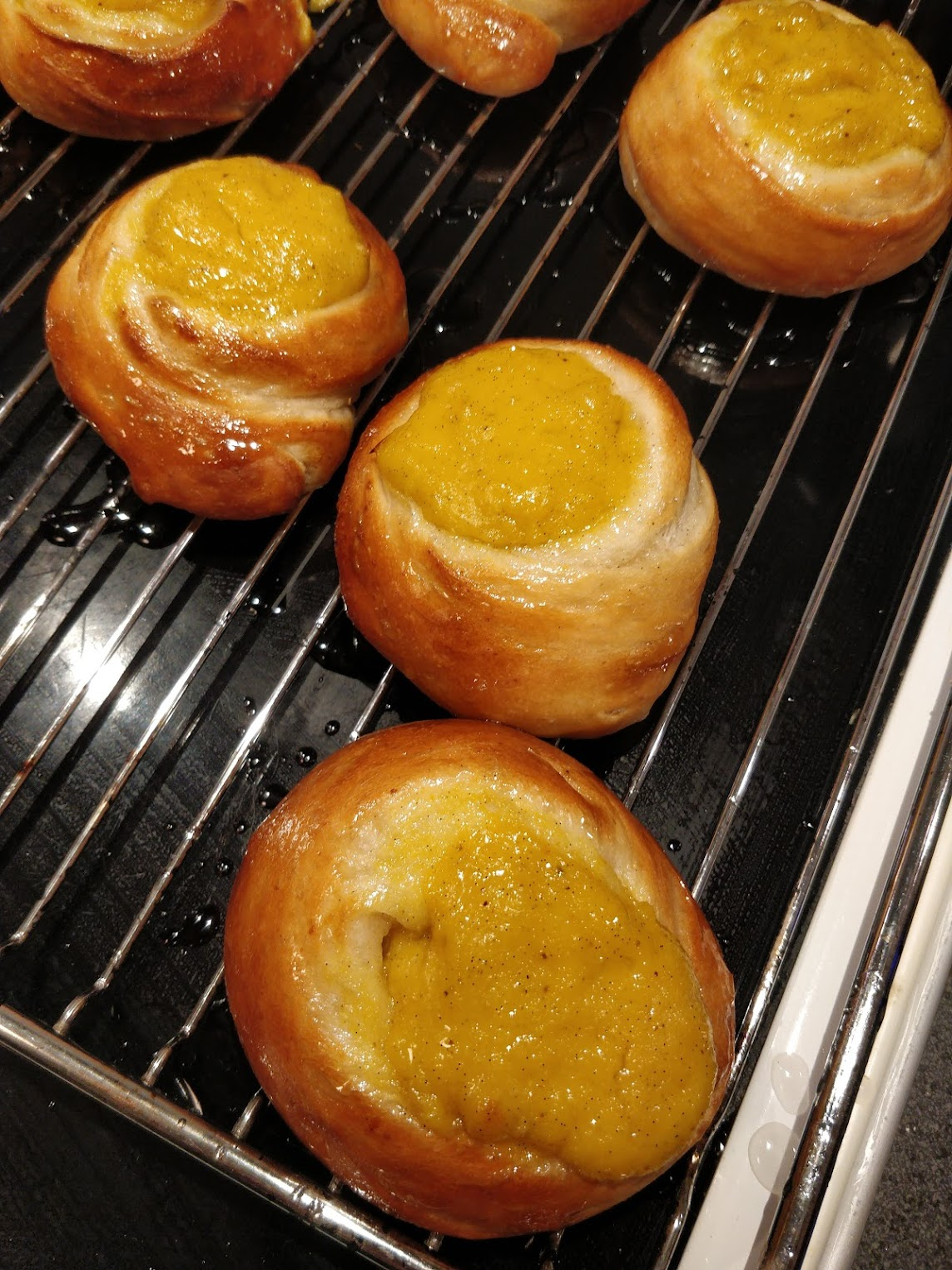
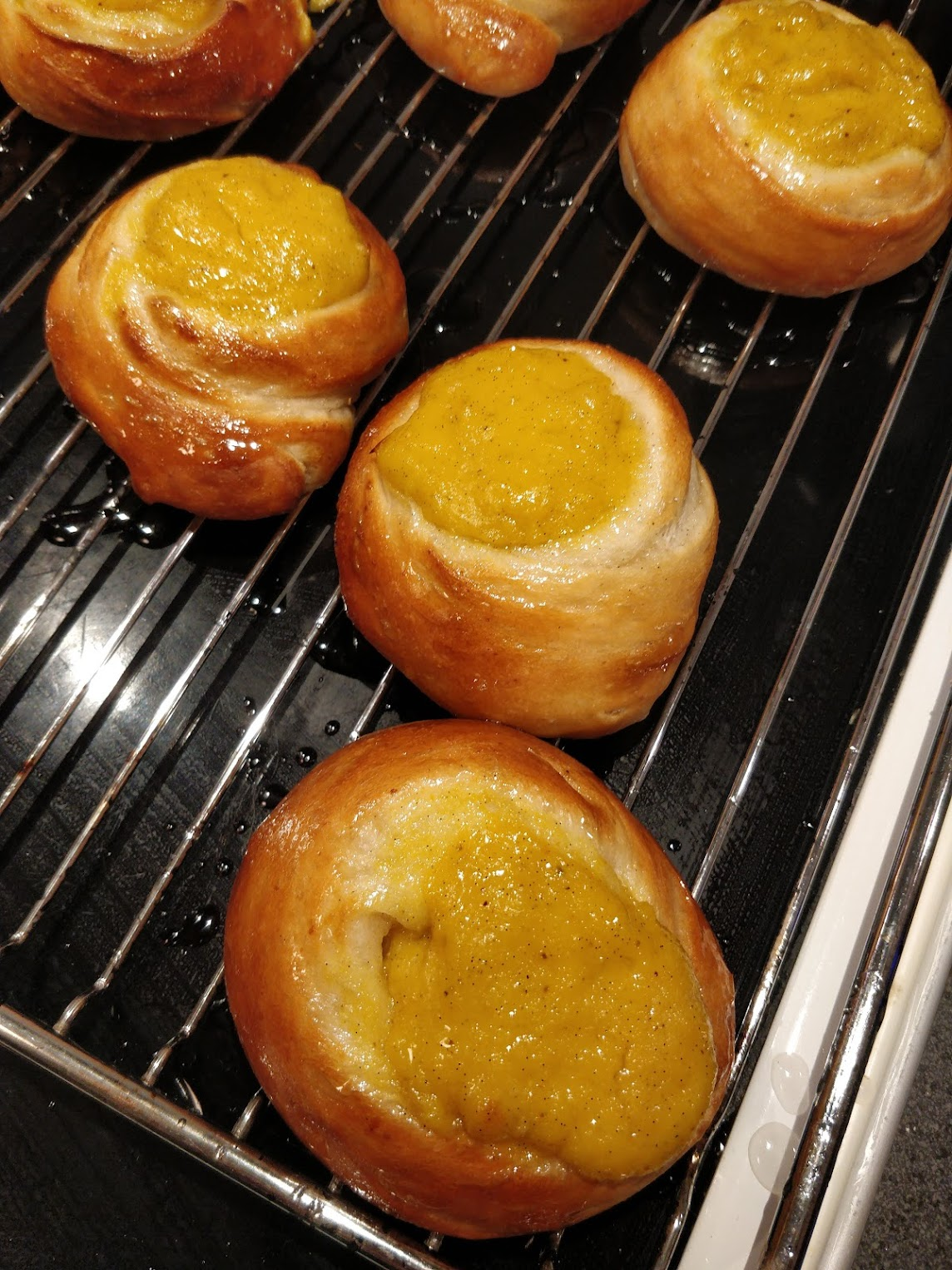 Final baked solbullar.
Review
I had a bit of a problem to blend the cashew nuts completely smoothly, because my stand mixer was broken and the Thermomix doesn’t handle such low quantities very well. So quite a lot of nut substance got left behind in the sieve.
The dough was very nice to handle; incredibly fluffy and yeasty and airy. Didn’t stick to the table though (with some flour), so was actually pretty easy to work with.
Didn’t get much definition on the buns, as it was impossible to roll out the dough evenly and handle it in a precise way. It was also hard to make an actual dip in the bun after shaping to make space for the custard.
The buns were very nice and fluffy, but I was a bit disappointed by the custard. It was a bit grainy (from the cashews) and it wasn’t as rich or creamy as I would’ve hoped. I think next time just some normal vanilla custard or pudding would be fine.
Using real vanilla was also maybe not worth it (for me). It wasn’t quite vanilla-y enough for me, bit too subtle.
Overall, I would make them again. Maybe just the dough though and making something like a cinnamon bun or a cardamom bun, instead of a custard bun.