A batch of kimchi product processed in a container has a distinct microbial community that is influenced by environmental factors, such as the major vegetable ingredients, temperature, seasonal changes and inoculated starter microorganisms, and is considered as an individual closed ecosystem. _- Park et al., 2012. Bacterial community analysis during fermentation of ten representative kinds of kimchi with barcoded pyrosequencing. _
Watery kimchi (dongchimi) fermentation
Jeong et al., 2013
https://doi.org/10.1016/j.ijfoodmicro.2012.10.015
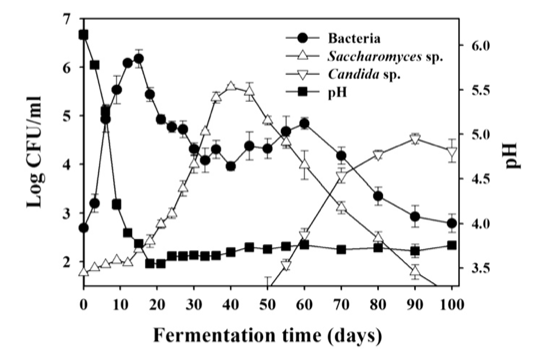 Changes in pH and colony forming units (CFUs) during the entire dongchimi fermentation period.
Dongchimi preparation
3 kg radishes, cut into large chunks, placed in plastic bag. 150 g seasoning mixture containing Korean leek, garlic and ginger (6:3:1) added, as well as 4.5 L of 4% sea salt brine. Dongchimi was stored at 4ºC during the whole fermentation.
Microbial profile during fermentation
- pH: Initial pH of 6.2 decreased quickly and reached 3.6 after 18 days of fermentation and stayed stable until the end.
- Bacteria: During early fermentation phase (0-15 days), increase in bacteria abundance was inversly correlated with pH (i.e. more bacteria, lower pH). Starting value: 2.7 * 10^3 CFU/mL, peak value at 15 days of 6.2 * 10^6 CFU/mL. Then rapid decrease to about 1 * 10^4 at 40 days.
- Yeast: Saccharomyces: Started at around 1.5 log. Increased when bacteria abundance decreased, reached maximum at day 40 at 5 * 10^5 CFU/mL. Then gradual decrease and not detected any more at 100 days. Candida increased from 50 days onwards and reached peak at 90 days (4.5 * 10^4 CFU/mL).
- Lactic acid bacteria: Leuconostoc, Lactobacillus, Pseudomonas, Pantoea and Weissella were present at day 0 (originating from raw materials). Bacterial community was rapidly dominated by genus Leuconostoc within 3 days of fermentation. Bacterial diversity decreased rapidly during the early fermentation period.
- Day 0: Diverse LAB such as Leuconostoc citreum (most abundant), Leuconostoc gasicomitatum, Leuconostoc lactis, Leuconostoc holzapfelii and Weissella cibaria.
- Day 3: Leuconostoc gasicomitatum became predominant, Leuconostoc gelidum second most common species. Both present and dominant until end of fermentation.
- Middle fermentation: Lactobacillus sakei appeared in low quantities.
- Metabolites:
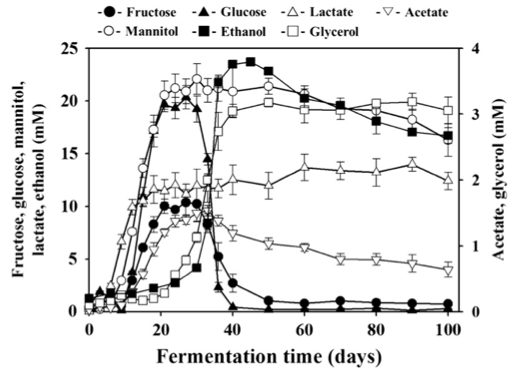
- Day 0-9: Concentrations of glucose and fructose low.
- Day 6: Concentration of free sugars increased rapidly. Increase of lactate, mannitol, acetate. Mannitol, lactate and acetate stay pretty stable during fermentation (only acetate drops gradually towards later stages).
- Day 30: Glucose and fructose drop rapidly again after day 30 and stay low. Ethanol increases rapidly.
Traditional kimchi fermentation
Park et al., 2012
Microbial composition of 10 different kinds of kimchi.
- 10 different kinds of kimchi: 7 with Chinese cabbage as main ingredient, 3 with young radish. 2 without red pepper powder.
- All stored at 4ºC throughout fermentation (for 35 days).
- pH: Immediately after production, all samples ad pH between 5.23 and 5.91. pH in samples without red pepper powder (baek-kimchi) decreased quicker than in samples with red pepper (baechu- and chonggak-kimchi). In all samples, pH levels of 4.2 to 4.5 were maintained until the end of the fermentation period.
Kim et al., 2021
Effect of temperature on microbial composition of kimchi.
- Chinese cabbage soaked in 10% brine for 12h, then washed 3x. Mixed with other ingredients (radish, green onion, red pepper, garlic, ginger, sugar, myeolchi jeotgal). Packed into plastic containers, stored at RT (25C), 10C, fridge (40C) or in a standard kimchi refrigerator (-1C).
- pH: Starting value 5.9. Increase in acidity and decrease in pH was slower at lower temperatures. Kimchi fermented at 4, 10 and 25C took about 30, 15 and 3 days, respectively, to reach pH 4.2.
- Cell count: The number of viable cells increased during fermentation for 20 days in the 4 and 10C fermented kimchi (max. 8 log CUF/mL). At 25C, the viable cell count increased rapidly during the first day and reached 8 log, and then gradually decreased during fermentation. At -1C, viable cell count increased slowly from 6.51 log at day 0 to 6.86 log at the end of fermentation.
- Microbes: A total of 3115 microorganisms were identified. 21 species were isolated belonging to Lactobacillus, Leuconostoc, Lactococcus, Weissella and Candida. The microbial communities showed a similar pattern in kimchi fermented at -1 and 4C, and a similar pattern at 10 and 25C.
- Lactobacillus sakei and Lactobacillus curvatus dominated all of the kimchi samples, regardless of fermentation temperature.
- At 10 and 25C, L. plantarum and L. brevis appeared during the early to medium stages of the fermentation and dominated in the end, whereas these species were not found in the -1 and 4C fermentations.