Thoughts on personal action
“ Grow Gardens, Grow Community, Grow awareness”
Reading list
A lot of people don’t know that we’ve largely won the battle to make people aware and concerned. The LA Times ran a well-intentioned editorial last year about how most Americans don’t care about climate breakdown. That was true once, but no longer is. A Pew Research poll in 2020 concluded that two-thirds of Americans wanted to see more government action on climate, but last summer the scientific journal Nature published a study concluding that most Americans believe that only a minority (37-43%) support climate action, when in reality a large majority (66-80%) does. That gap between perceived and actual support undermines motivation and confidence.
All mining needs to be done with respect for the land and people in the vicinity, but the impact of mining for renewables needs to be weighed against the far more devastating impact of mining for and burning fossil fuel.
We have the solutions we need in solar and wind; we just need to build them out and make the transition, fast. Looking to wildly ineffectual carbon sequestration and other undeveloped technologies as a relevant solution is like ignoring the lifeboats at hand in the hope that fancy new ones are coming when the ship is sinking and speed is of the essence.
A climate story we urgently need is one that exposes who is actually responsible for climate chaos. It’s been popular to say that we are all responsible, but Oxfam reports that over the past 25 years, the carbon impact of the top 1% of the wealthiest human beings was twice that of the bottom 50%, so responsibility for the impact and the capacity to make change is currently distributed very unevenly.
Usually if I ask people what they’re doing about the climate emergency, most will talk about what they’re not consuming or doing – but these will never add up to the speed and scale of change needed to change the system.
⇒ We need more people doing something instead of not doing something. Action is better than silent sacrifice
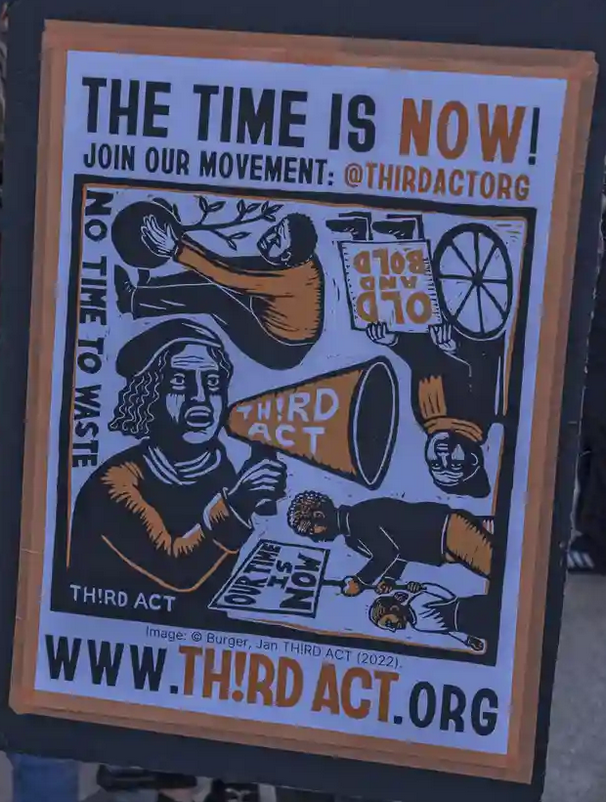 From: A climate activist holds up a sign during a protest against financial firms investing in fossil fuels in New York in 2022. Photograph credit: Ron Adar/REX/Shutterstock
The impact of your diet and how you get to work may pale in comparison to the impact of your money in the bank.
In 2021, the organisation Carbon Tracker put out a report that showed current technology could produce 100 times as much electricity from solar and wind than current global demand.
Engineer and energy expert Saul Griffith recently wrote: “Most people believe a clean-energy future will require everyone to make do with less, but it actually means we can have better things.”
In 2019, Swedish climate activist Greta Thunberg said we must embrace “cathedral thinking”, adding: “We must lay the foundation while we may not know exactly how to build the ceiling.”
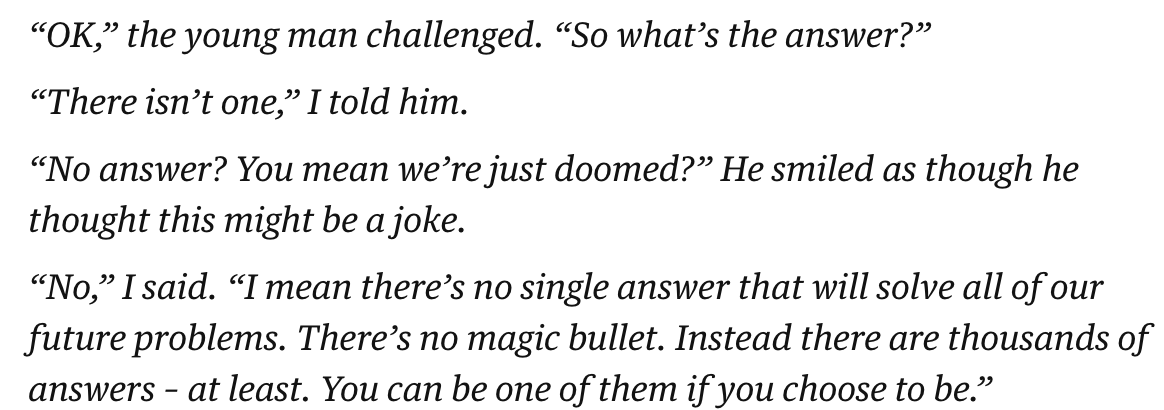 From an essay by Octavia E. Butler.
-
Scales of Change - podcast
-
Against thermochauvinism - From Andrew Dana Hudson’s newsletter.
There is something Eurocentric, colonialist, even quasi-racist about thermochauvinism. Brown and Black people live in warmer places, and are then depicted as lazy or uncivilized for the ways they adapt to the heat. White people live in cooler place and are thought to be industrious for adapting to the cold. A siesta or a dip in the river is a primal throwback, while hygge is advanced cultural technology.
Cooling technology is often more efficient, more easily electrified (heat pumps!) and can conveniently be powered by solar energy which is much more abundant throughout the hotter months. So perhaps places with very hot summers are already more climate-resiliant than those in colder climates that will need to retrofit buildings with cooling units in the decades to come.
(…) labeling certain fish as ecofriendly had little effect on most consumers. The labels did not diminish the demand for overfished seafood. In fact, the only people who were found to be influenced by the labels already belonged to environmental organizations.
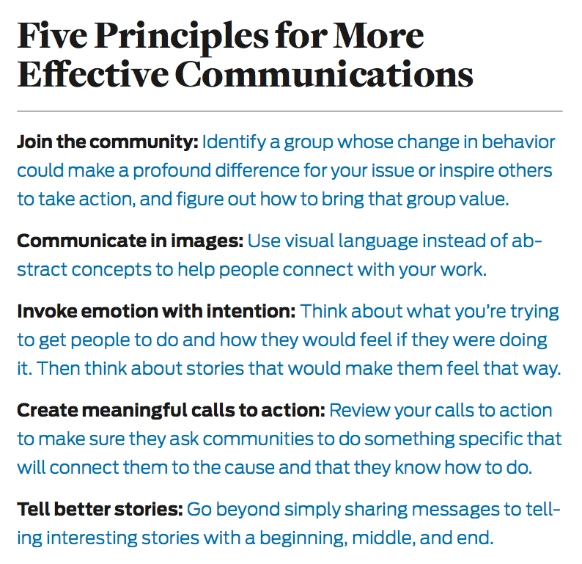
To move the needle on the issues we care about the most, research and experience both show that we must define actionable and achievable calls to action that will lead a specific group of people to do something they haven’t done before.
There are four essential elements to creating a successful public interest communications campaign: target your audience as narrowly as possible; create compelling messages with clear calls to action; develop a theory of change; and use the right messenger.
Identifying the right target audience and delivering a clear call to action that people will act on isn’t dark magic. It requires having a theory of change—a methodology or road map for how you will achieve change that includes objectives, tactics, and evaluation— and knowing the issue well enough to know where change will have its greatest effect.
- The Science of what makes people care
- I’ve learned that people will forget what you said, people will forget what you did, but people will never forget how you made them feel (poet and writer Maya Angelou).
- Think of communication less as a megaphone and more as a gift to your audience. Does it help them solve a problem? Does it make them feel good about themselves or see themselves as they want to be seen? Does it connect to how they see the world and provide solutions that are actionable? If we want people to engage and take action, we have to connect to what they care about and how they see themselves.
- Pride can be exceptionally powerful. Researchers have found that people anticipating feeling pride in helping the environment were more likely to take positive action than those anticipating guilt for having failed to do so.
- People fail to act not because they do not have enough information, but because they don’t care or they don’t know what to do.
Stanford Social Innovation Review Good articles about social change with a big focus on climate action.
Reading list (pdf, in German) - Die besten Bücher zur Klimakrise 2024, von der Robert Jungk Bibliothek für Zukunftsfragen in Salzburg. Zum Beispiel: Das Ender der Erschöpfung (Katharina Mau), KlimaUNgerechtigkeit (Friederike Ott), Das nomadische Jahrhundert (Gaia Vince).
Gloom and Doom, oder gutes Leben für alle? Die For-Future-Bewegung hat immer noch ein Kommunikationsproblem - published in Der Standard and Scientists4Future Österreich
A working class climate agenda - Stop Greed, Build Green
Environmental initiatives
https://www.newweather.se/hem1 Badvertising. Reports about flying, bilism, etc.
https://klimataktion.se/lokalorganisationer-3/skane/ Klimataktion - Skåne chapter
https://endecocide.se/ End Ecoside Sweden
Circular cities
Solarpunk
- Primer on solarpunk: https://mastodon.social/@tsouthard/109685358001761535
Postgrowth / Degrowth
The proposition of degrowth is rather simple: removing concepts such as GDP and the destructive fantasy of endless economic growth from the heart of social, civic, and economic life. What that looks like and how it can be accomplished (particularly in an organized, just way) are among the main points of discussion. (…)
Degrowth places a higher value on things like maintenance and care work than ‘scaling up’ or returns on investment.
From this essay
- Degrowth primer
- Uneven Earth website - Where the ecological meets the political https://unevenearth.org/
- Lots of resources about post-growth topics https://unevenearth.org/resources-for-a-better-future/
- E.g. Jevon’s paradox https://unevenearth.org/2020/06/jevons-paradox/
- The Ideology of Growth and its Origins https://strangematters.coop/the-future-is-degrowth-excerpt-history-of-growth/
- Build a library of materials for Postgrowth/Degrowth Degrowth Library
- Degrowth Institute Malmö
Natural systems as legal persons
Despite the anthropocentric approach to nature, legal personality of rivers and other parts of the natural environment is becoming increasingly popular and more frequently explored by various legal systems. Whanganui in New Zealand became the first river in the world to be recognized as a legal person. The same legal solution was used in Canada, India, Ecuador, and Colombia. In Europe, the Spanish precedent is paving the legislative path, setting an example for countries where economic, agricultural, and tourist development has caused environmental degradation and the mass extinction of living organisms.