Choice of legumes/grains
- Soy beans are neutral in taste (somewhat nutty), ferment extremely well and give a pleasant texture (between mealy and chewy).
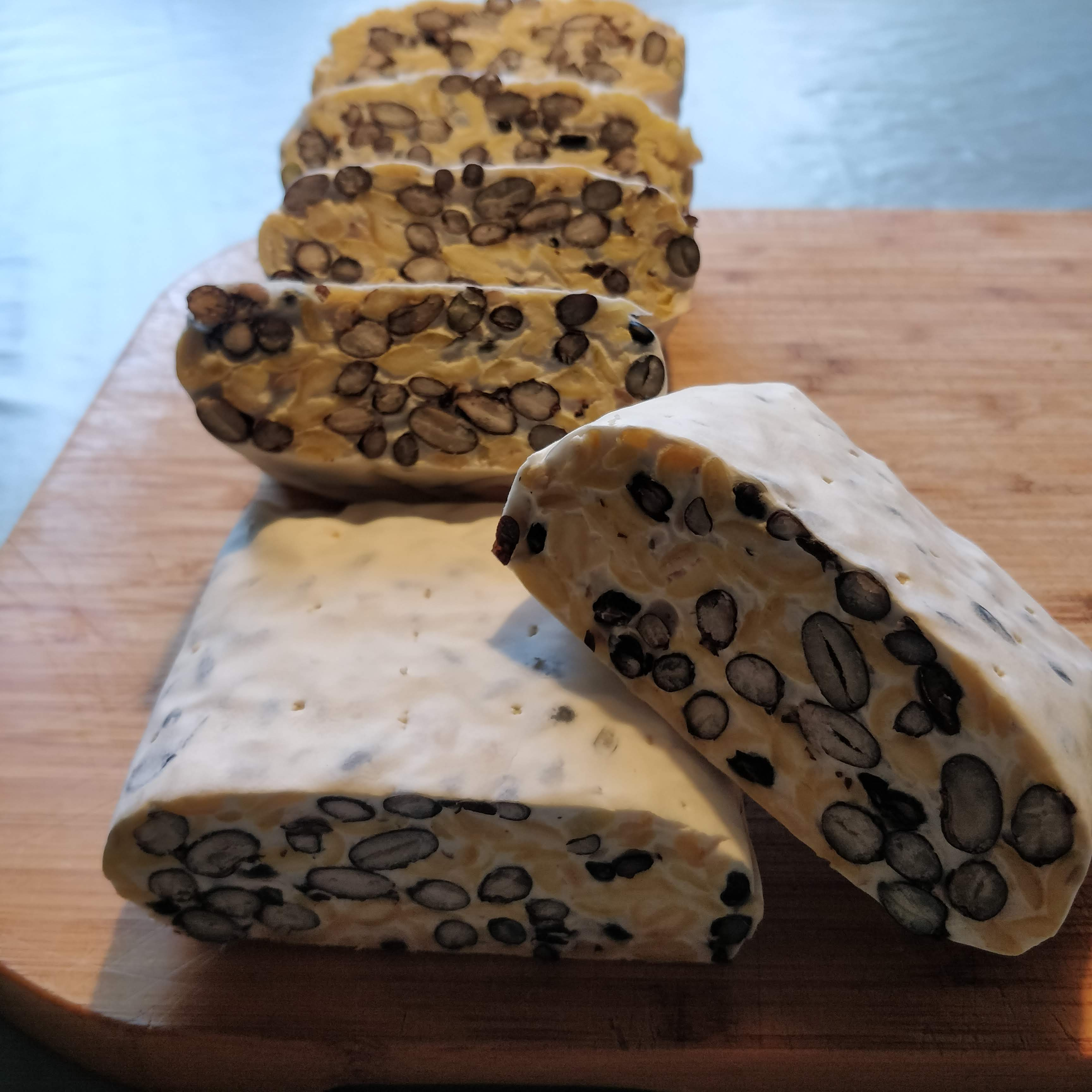
- Black beans look very nice, but have a tough skin that makes it hard for the mycelium to penetrate (tempeh cake doesn’t hold together well). Best mixed with other “softer” legumes, like Toor dal or soy bean.
- Same with “tough” lentils (e.g. Gotland lentils): they don’t make a good cake on their own, but are a good addition to other legumes that would give a too soft cake.
- Fava beans give a starchy/meaty, but quite soft texture. Would benefit from mixing with something tougher (e.g. Gotland lentils).
- Quinoa gives a very dense and chewy texture. Grows VERY quickly and overheats very easily!
- Toor dal can get quite chewy and meat-like, especially when it’s boiled and fried after fermentation.
Fermentation
- Rather slightly too cold (29 ºC) than too warm (>35 ºC).
- It’s good to test a new batch of starter culture first, to see how active it is. But generally using a bit less starter and incubating for longer at not too high temperature gives the best tempeh. Adding a lot of starter culture results in too rapid fermentation ⇒ too much heat development ⇒ overripe (ammonia) taste and black sporulation spots.
- Adding salt to the bean cooking water improves the taste only a tiny bit. It’s not really worth adding it, and it might slow down fungal growth. It’s better to simmer in soy-water afterwards, or marinate.
- Good sized bags are e.g. Zip bag 16x12cm, PE-LD (ordered from Fyndiq). Fill with about 200-250 g of cooked beans for nice-sized block. Not more, otherwise it gets too thick and develops too much internal heat during mycelium growth.
Cooking
- When boiling a tempeh block in salt water, boil for 4-5 min total, otherwise it gets too soggy and the legumes get too cooked.
- Add the vinegar to the last few minutes of boiling water (instead of after boiling and draining the beans). This way they dry quicker after cooking, because you don’t add additional (cold) liquid to the drained beans, which counteracts some of the steaming-off.
Storing
- Do not store a fresh tempeh block for more than 2 days in the fridge without prior heat treatment (see below)! It continues fermenting and will start to taste very funky.
What has worked best so far
Fermentation
For all legumes:
- Add 4 Tbsp/kg (dry weight of legumes) apple cider vinegar after cooking, then let dry a bit, e.g. in a 50C oven for 30-60 min with occasional stirring.
- Mix with 1-2tsp/kg (dry weight of legumes) tempeh starter.
- Fill into plastic bags or glass dishes, nicely compact. For plastic bags, poke holes with a wooden skewer every few centimers.
- Cover with a clean tea towel and place in the oven onto a heating mat, place the temperature sensor into one of the cakes and set the thermostat to 30C. Close the oven door and just leave it without turning on the oven. Observe the temperature and when it goes over 32C, turn off the heating pad (for a while). If it continues to go up, remove the tea towel, or even take the cakes out of the oven. It really shouldn’t be much warmer than 32C for a long time, otherwise it tastes too fermented. Ideal is 30C.
- If it looks done after less than 24h or if it starts to get black sporulation spots, place it in the fridge for 1-2 days for slow continued growth.
Generally, after 30-40h the cakes are sufficiently densely permeated with mycelium to hold together when cut and marinated. Much earlier than that, and it’s a crumbly bean mess that tastes more like just cooked beans than tempeh. Much longer than that and it can get very squidgy and have a very fermented, funky taste (which some people like, but I don’t).
Ideal time plan
- Soak beans (20:00) over night (12-24h).
- Cook beans in the afternoon (15:00), dry and let cool down (16:00).
- Inoculate in the afternoon (16:00), place on heating mat/in oven. During the first 12h there’s little risk of overheating, so no observation necessary.
- During the next day, occasionally check the thermometer or touch the cakes. If temperature gets too high, place them in a cooler place to “calm down” the fermentation. 8:00 (=16h), 12:00 (=20h), 16:00 (=24h), 22:00 (=30h).
- In the evening of day 2, either place the cake in the fridge if it is nice and dense. If it still looks a bit loose, just leave it on the countertop in the open (no heating) over night and place it in the fridge the next morning.
- Proceed with heat treatment, cooking it right away, or placing it in the freezer.
Substrates
Soy beans
250 g, rinse and soak o/n. Try to remove as much skin as possible from the beans by pressing them through your hands. Doesn’t need to be 100%, but good if about half of the beans loose their skin. Cook for 50 min. Drain and let steam off. Add vinegar, mix, let dry. Nice on its own or mixed with other legumes. Soy beans increase in weight about 2X during cooking.
Black beans
250g, rinse and soak o/n, cook for 45 min. Drain and let steam off. Add vinegar, mix, let dry. Squash some beans with a fork to create some easily available starch for the fungi colonisation (this definitely helps with growth!). Don’t bother chopping in food processor or dehulling. Best to mix 1:1 or 3:2 with a legume with thinner skin, e.g. Toor dal. Black beans increase in weight about 1.8X during cooking.
Toor dal
125 g, rinse and soak o/n, cook for 10 min. Drain and let steam off. Add vinegar, mix, let dry. Best to mix 1:1 or 2:3 with a legume with thicker skin, e.g. black beans, since Toor dal on its own ferments SUPER fast and often over-ferments.
Grey peas
Did not work at all Fava beans with salt, grey peas (2020-11-24), they have a too tough skin. Need to be dehulled and/or split.
Fava beans
Soak o/n, cook for 2-2.5 min. Nice, slightly chewy tempeh Fava beans with salt, grey peas (2020-11-24)]. Need VERY little cooking. Fava beans increase in weight about 1.7X during cooking.
Adzuki beans
Soak o/n, cook for 8 min without dehulling. They will lose most of the pretty red colour during cooking. Don’t work well on their own (don’t stick together). Need some softer legume mixed in (e.g. Toor dal, Fava bean, soy bean). Adzuki beans increase in weight about 1.8X during cooking.
Post-fermentation
When placed in the fridge, it continues to ferment and change in taste and texture. So for slightly under-fermented cakes that’s a good thing to do for 1-2 days. For well-fermented cakes however, I wouldn’t store it in the fridge without heat-treating (and inactivating, i.e. killing) the fungus.
Heat treatment
Remove the tempeh cake from the plastic bag or glass dish and wrap in aluminium foil. Place in 85°C oven for 30 min, then let cool down on the counter top. After this, the tempeh is good in the fridge for about 1-2 weeks.
Also possible (if right plastic bags are chosen) to heat-treat in the bag. E.g. LD-PE has a melting point of >105°C. Wrap in aluminium foil (to prevent loss of moisture) and leave in 85°C oven for 45-60 min. The tempeh block shrinks a bit inside the plastic bag.
Freezing
Very conveniently, the finished cakes can just be thrown into the freezer for long-term storage and thawed whenever you want to eat it. Best is to place it in the fridge on the day before consumption and let it thaw slowly. It’s also very convenient to add marinade to the frozen cake and let it marinate and thaw at the same time in the fridge over night.
Gifting tempeh
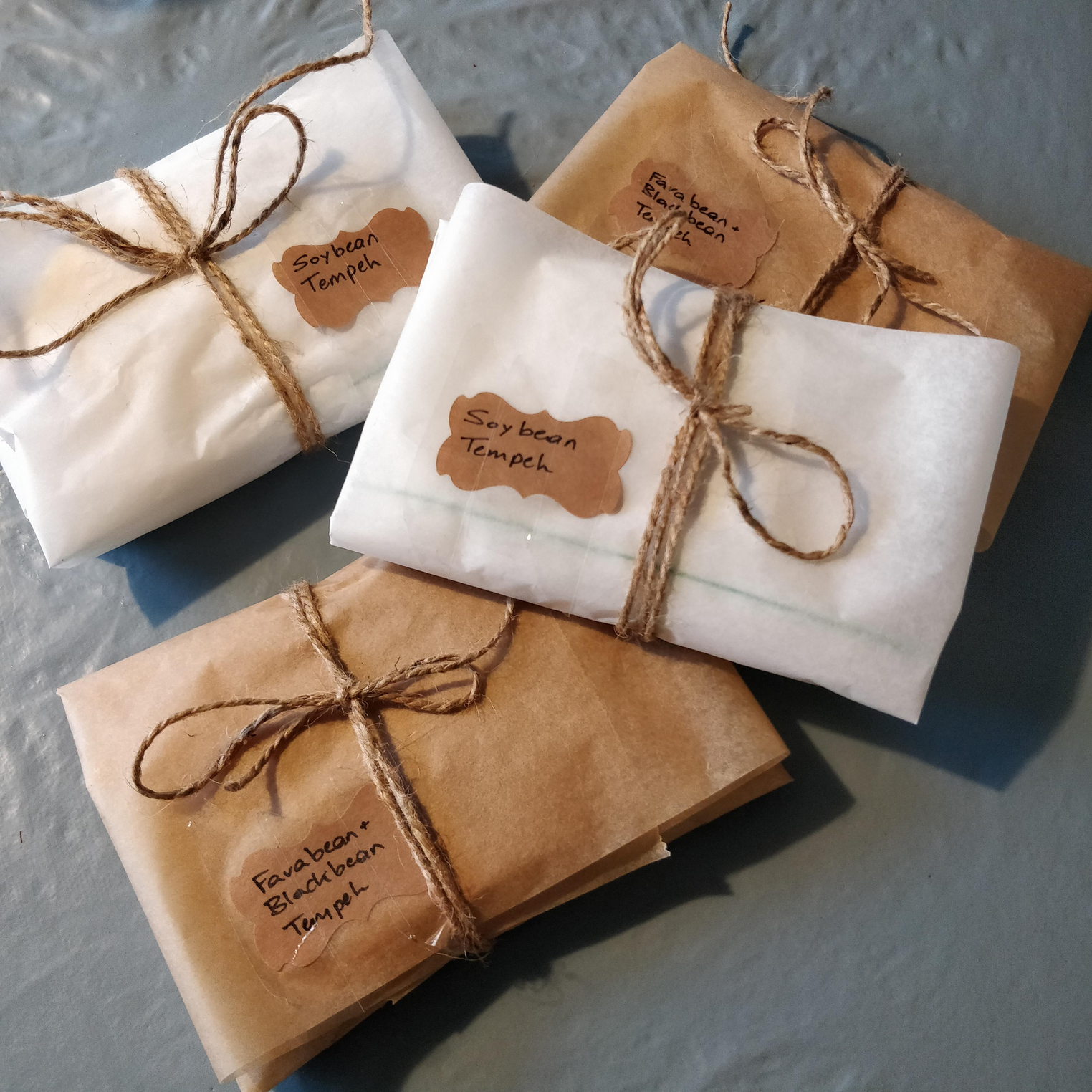
A nice way to give tempeh blocks to other people is to wrap them into baking paper or sandwich paper as an outer layer (blocks still inside the plastic bag that was used for fermentation).