Different Indian dals (2020-09-09)
Test: Chana dal, Toor dal, Green mung dal
Standard recipe (according to [Miso, Tempeh, Natto (Shockey)](Miso, Tempeh, Natto (Shockey)), adapted.
- Material: Chana dal, Toor dal, Green mung dal from Indian shop, Herkulesgatan, Gothenburg. 125 g dry dal.
- Soak: Wash and soak in water for 10h, then change water and soak for another 12 h (not necessary, but I didn’t have time to cook it earlier). Total soaking 22h. Green mung dal had lost all its husks and was very easy to dehull. Looks just pale yellow. Toor dal and Chana dal have increased in size quite a lot and have the consistency of raw potato.
- Cook: Chana dal and Green mung dal: 5 min; Toor dal: 10 min. Chana dal has a nice bite and a bit of starchyness, but good flavour. Toor dal has a nice bite, but starchy and a bit watery.
Could use less soaking or less cooking time.Green mung dal is nicely al dente and holds together well, has lost the green shells. - Inoculation: 0.5 Tbsp apple cider vinegar added (4 Tbsp/kg), mix and return to warm pot to steam off, Then let cool down on tray and add another 0.5 tsp vinegar, mix. Add 1/4 tsp (2 tsp/kg) tempeh starter (topcultures). Spread in perforated plastic bags, incubate in cupboard above freezer.
- Growth: Passive warming, not controlled. Start 09-09-2020, 12:00 (27°C).
- Toor dal: Move to room temperature after 23h, total inucubation time: 44h.
- Chana dal: Total incubation time (in cupboard): 44h.
- Green mung dal: Move to room temperature after 23h, total incubation time: 48h.
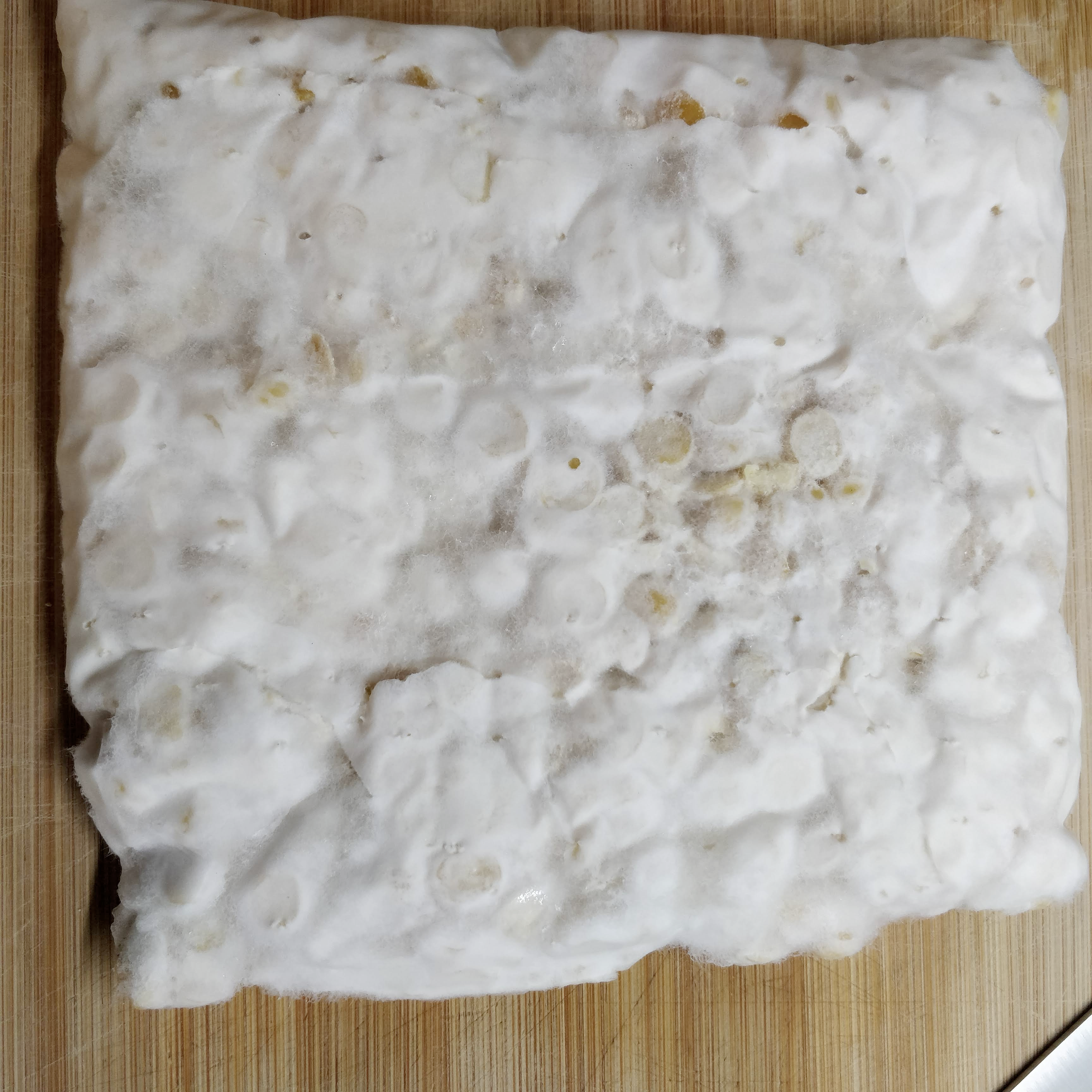
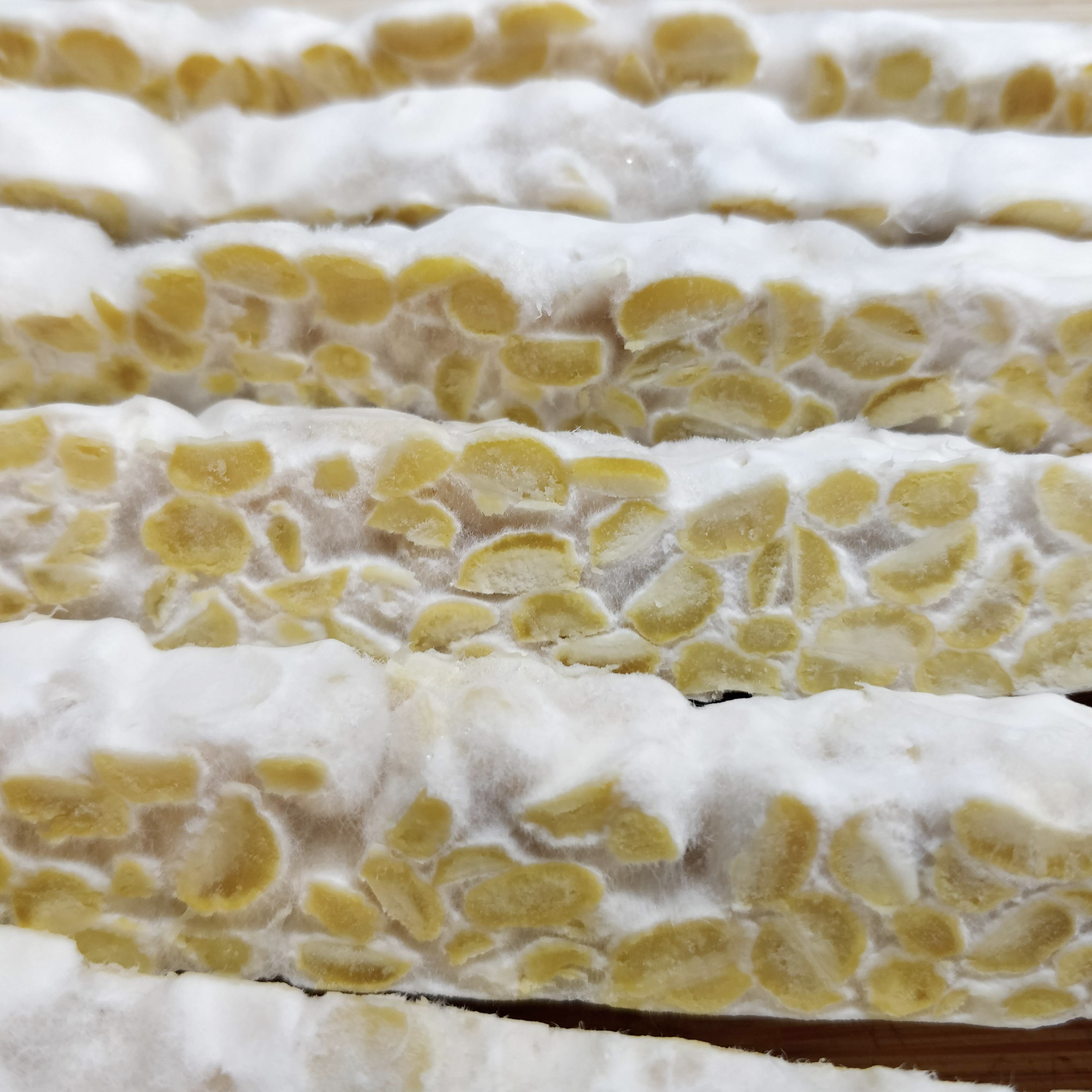
Chana dal
Slower to colonise than the others, so left in cupboard for much longer. More and bigger holes made, because it was wet inside the plastic bag. Needs to be dried off better! Nice dense, fluffy mycelium, no spores. Slightly sour and damp smell.`
Toor dal
Good colonisation, got warm quickly (32°C). At the end, a bit wet and slightly yeasty, alcoholic smell. More mycelium on the sides than in the middle, but nicely colonised through and through. Tiny spores in one corner.
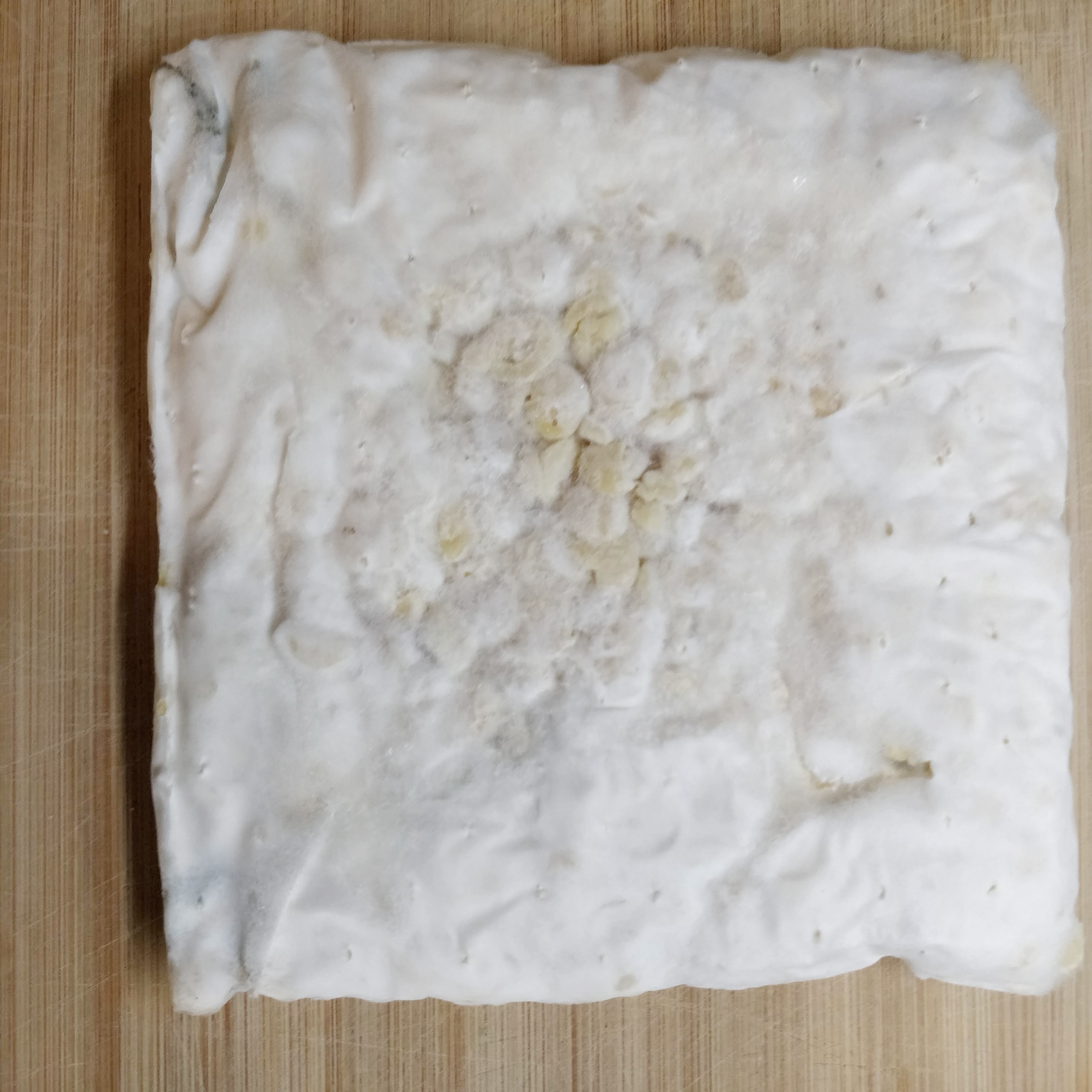
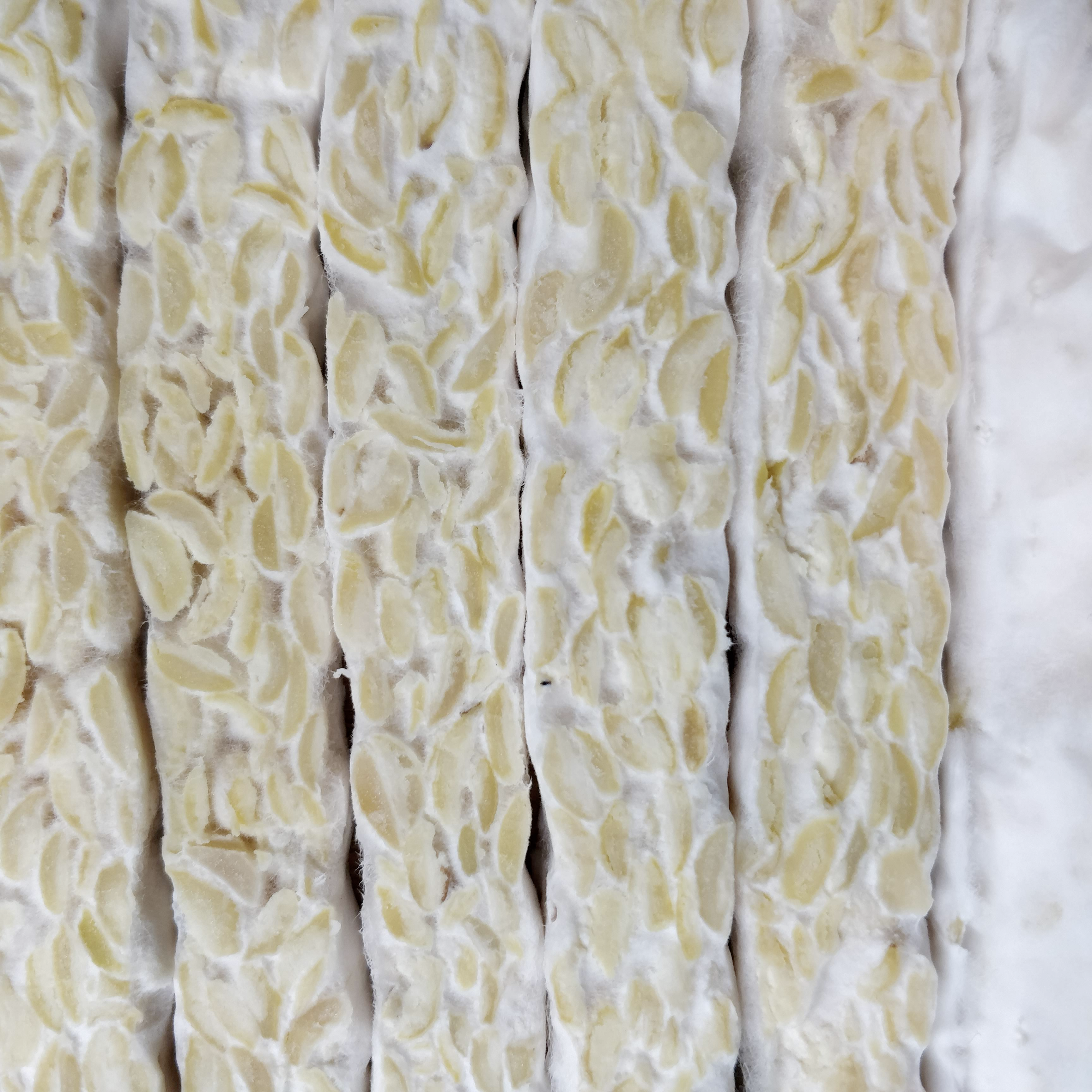
Green mung dal
Good initial colonisation, taken out after 23h at 34°C. Mycelium took longer to get dense. At the end, very strong, sharp alcoholic smell. Not well grown in the middle. No spores visible. Doesn’t smell pleasant at all. Too small grains! It gets too dense and wet. Mix with something bigger.
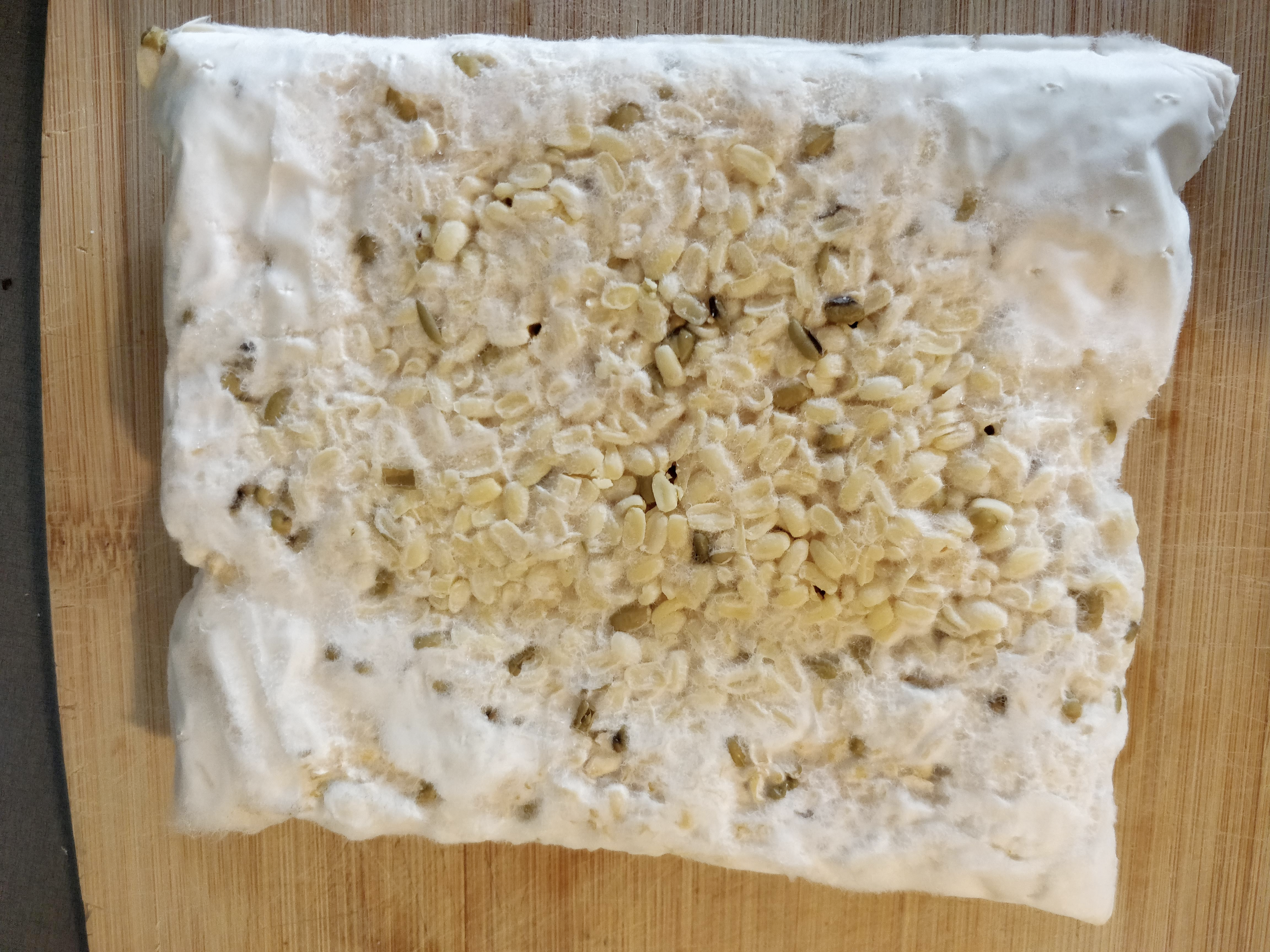
Different Swedish legumes/grains (2020-09-19)
Test: Gula ärtor (yellow peas), Gotland linser (lentils from Gotland), Lins Anicia (lentil Anicia), Favabönor (fava beans, dehulled), bruna bönor (brown beans), vit quinoa (white quinoa), compare to Toor dal.
- Material: Legumes from FRAM, Gothenburg. 125 g dry legumes/grains each.
- Soaking and cooking (until al dente):
- Yellow peas: Soak over night, cook for 10 min. Nice texture, grassy taste. Dehulling was a pain and there were weird peas that didn’t get soft (~1%).
- Gotland lentils: No soaking. Cook for 12 min. Nicely separated. Very good, fresh, chestnutty taste.
- Lentil Anicia: No soaking. Cook for 5 min. Slightly tougher than Gotland linser, but also pleasant nutty taste.
- Fava beans: Soak over night, cook for 5 min. Starchy, not a strong bean taste.
- Brown beans: Soak over night, dehull, boil for 18 min
—> much too long! Very mushy!Starchy, clean taste. Dehulling was a pain, quite tough shell. - White quinoa: No soaking. Rinse very thoroughly and cook for 9 min in a lot of water. Fluffy and nice pop, slightly bitter, earthy taste, very voluminous.
- Toor dal: Soak over night, cook for 10 min.
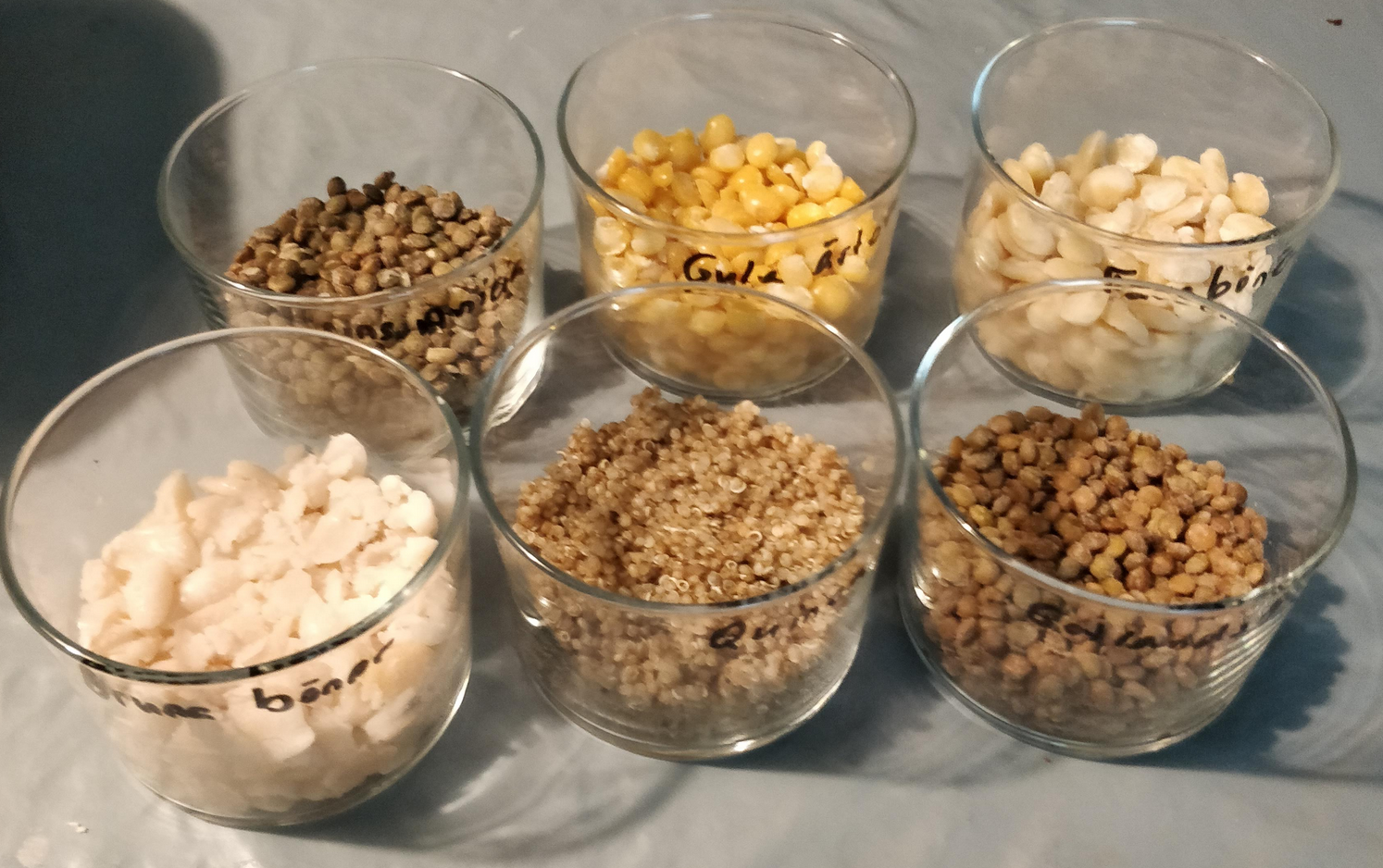
- Inoculation: Drain, add 1 Tbsp apple cider vinegar (4 Tbsp/kg), mix and heat up in dry pan to remove moisture. Spread on clean tea towel and let dry a bit. Mix in a tub thoroughly with 1/4 tsp (2 tsp/kg) starter (topcultures).
- Growth:
- Open: Prepare 7 portions in plastic or glass jars for open incubation in sous vide immersion water bath, set to 32°C water temperature (=“open”). Incubation start, 19-09-2020, 21:00. Sous vide immersion cooker is very loud, but temperature in water bath was very even. Water bath shut off 22-09-2020, 8:00, for another 5 h. Total incubation time: 40h. Store in fridge for 2 days.
- Plastic: Prepare 7 bigger portions in perforated plastic bags for incubation above freezer (27°C at the start) (=“plastic”). In the cupboard the temperature was varied, but once the mycelium started to take over it got VERY warm in some samples (35-43°C!!). Bags put at room temperature 22-09-2020, 8:00, for another 5 h. Total incubation time: 40h. Store in fridge for 2 days.
Results
-
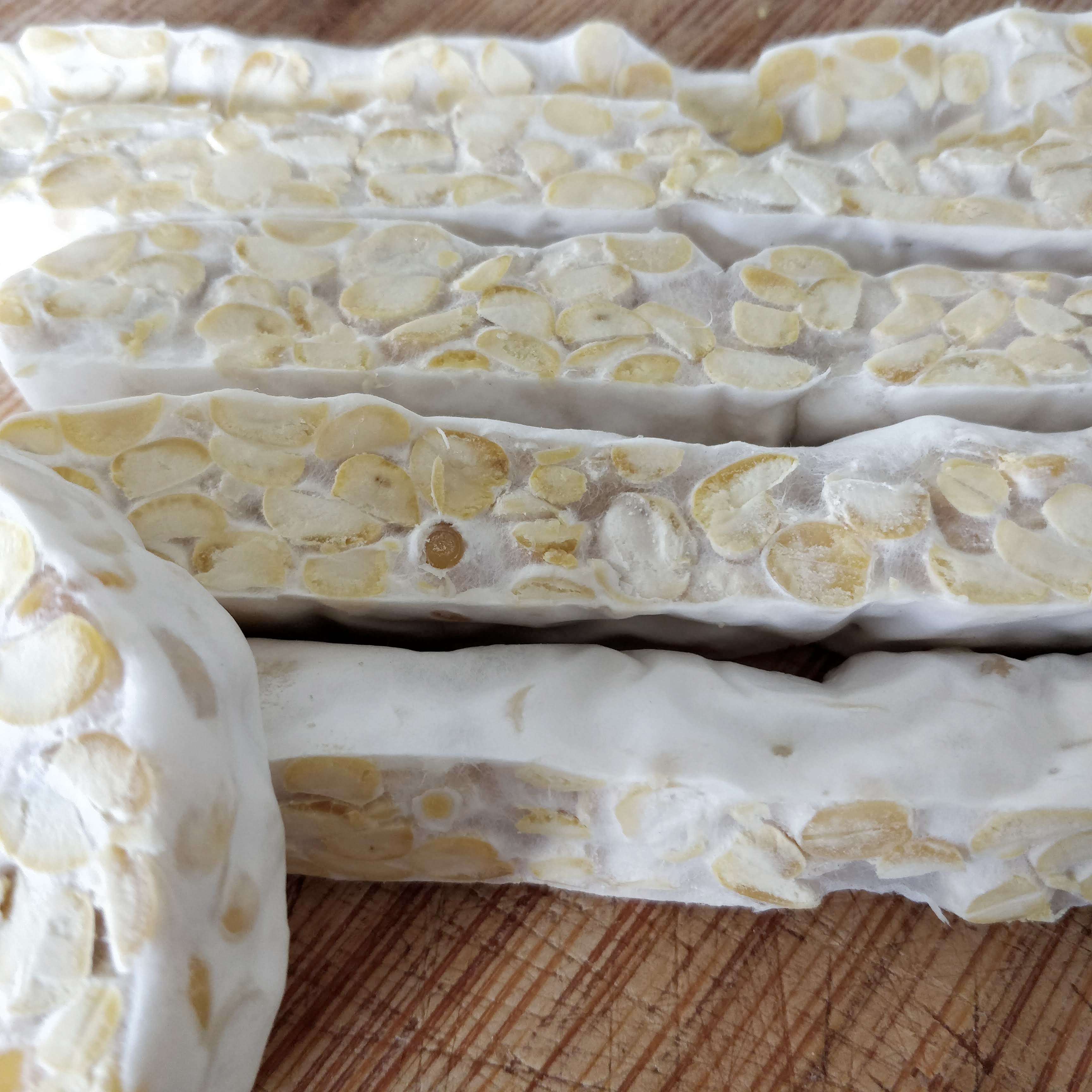
Yellow peas: Smell is quite mild, slightly mushroomy. Open: Very nice, dense little block with thick mycelium all around. Not too fluffy on top, little sporulation, mild smell. Plastic: Block is nicely dense, but a bit irregular because the peas are quite big and the bag was lying on a rack. Both: Nice to cut, but slightly fragile due to size of beans
—> maybe chop a little bit before mixing with the starter?Looks good, basically like toor dal tempeh. But a few harder peas are visible in the mix. Interesting to see how they will be when cooked/fried.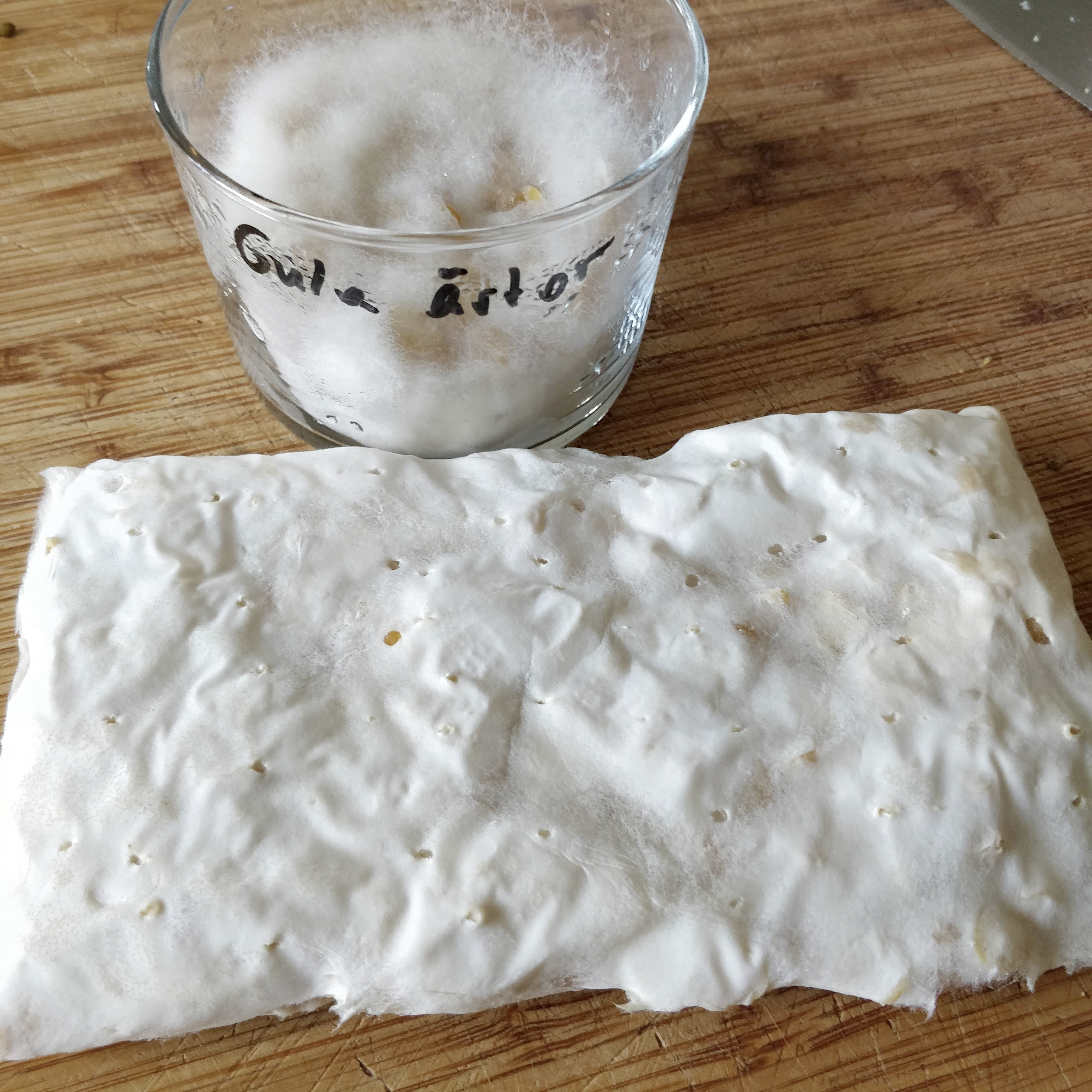
-
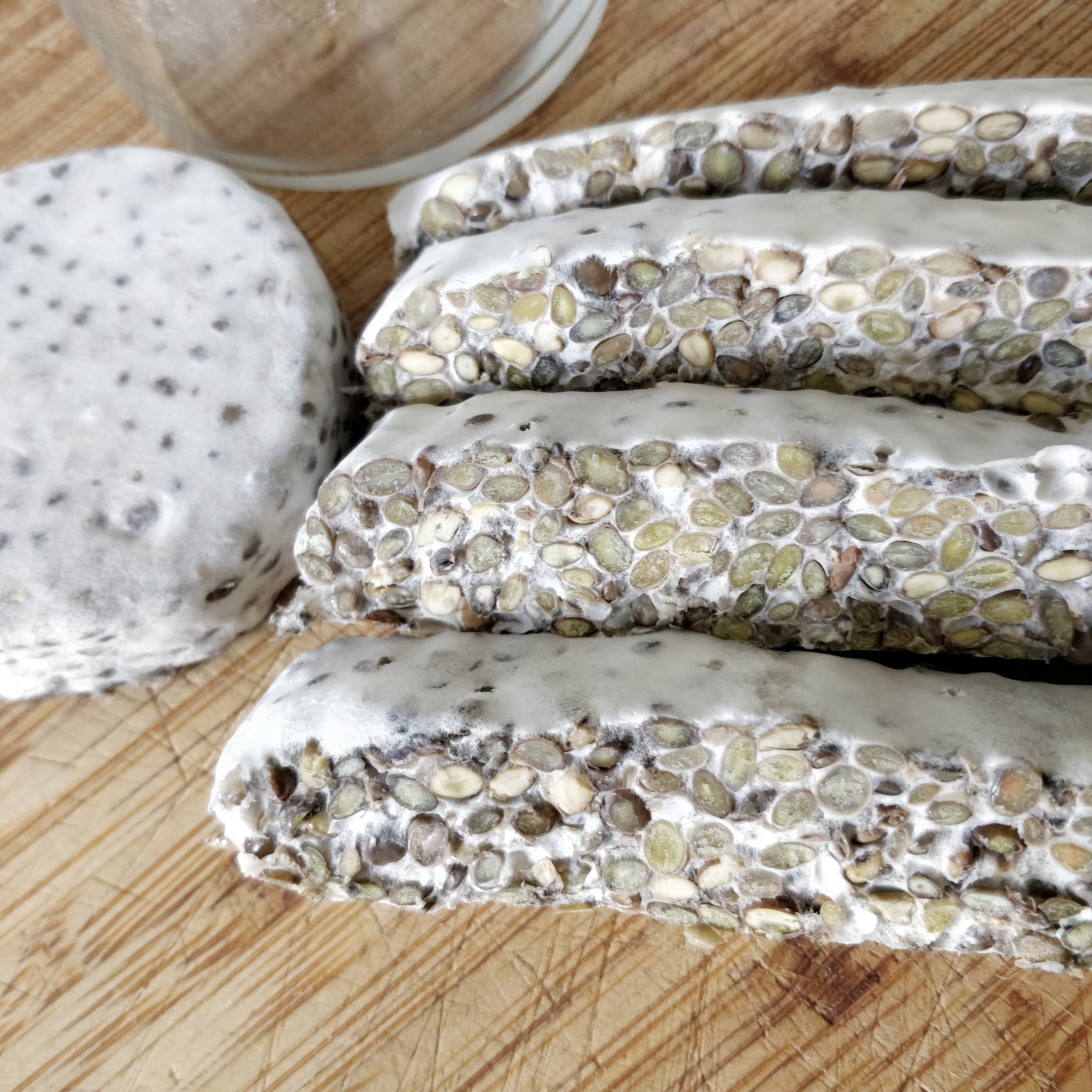
Gotland lentils: Open: Very fluffy on the top and a tiny bit sporulation. Black colour is visible underneath, but that’s from the lentils, not spores. Plastic: Quite dense block, no wet or empty bits. Nice to cut and looks very pretty, but the lentils start falling out of the block a bit. When boiled, quite many lentils fall out, leaving small holes in the block. Not holding together as well as e.g. brown beans. Quite brittle after boiling
—> mix lentils with something else!Both: Slightly unpleasant dank smell, similar to the quinoa samples.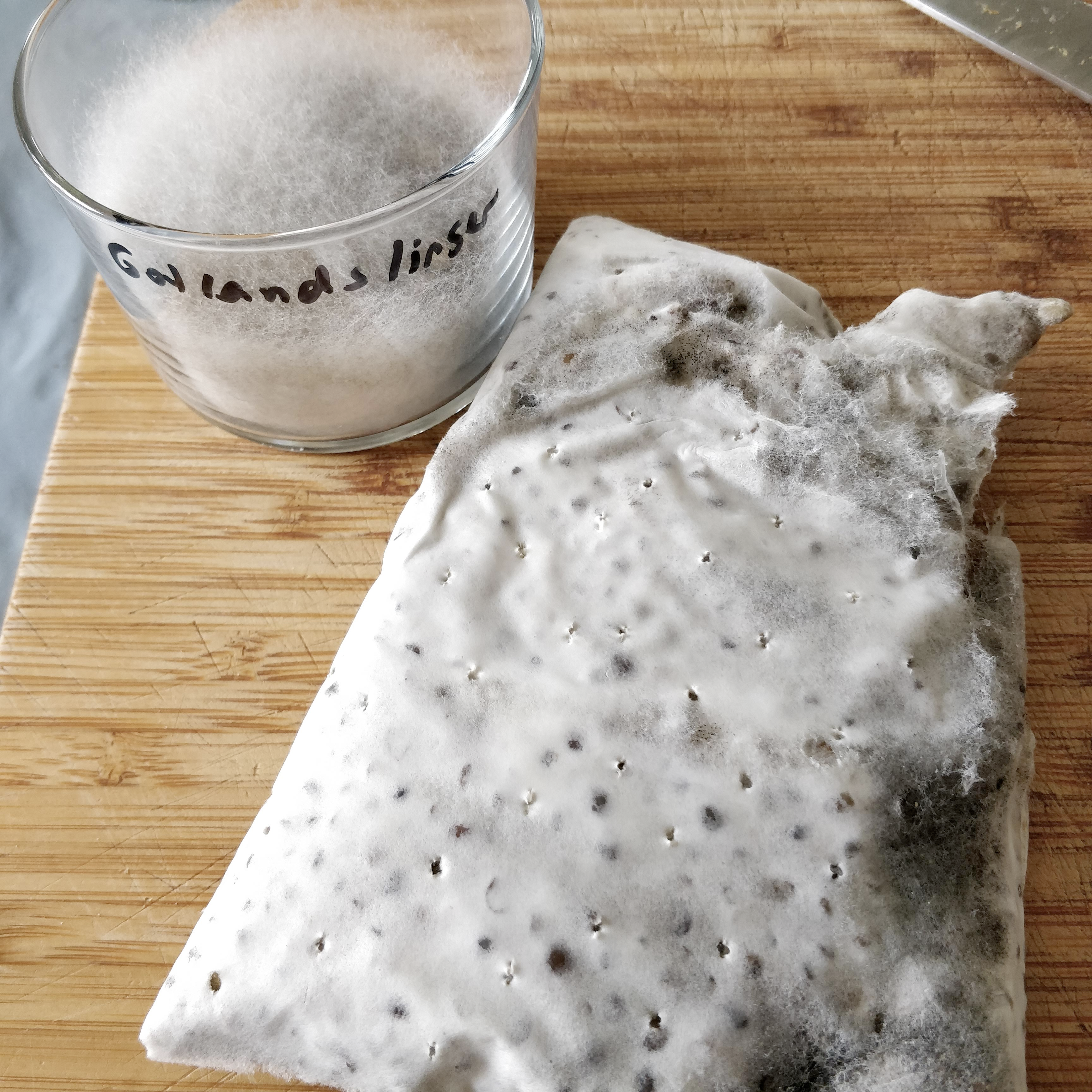
-
Lentils Anicia: Didn’t develop mycelium at all, neither in bag nor in cup, and also not after > 48h incubation. Discarded.
—> Too tough outer shell, or did I forget the starter? -
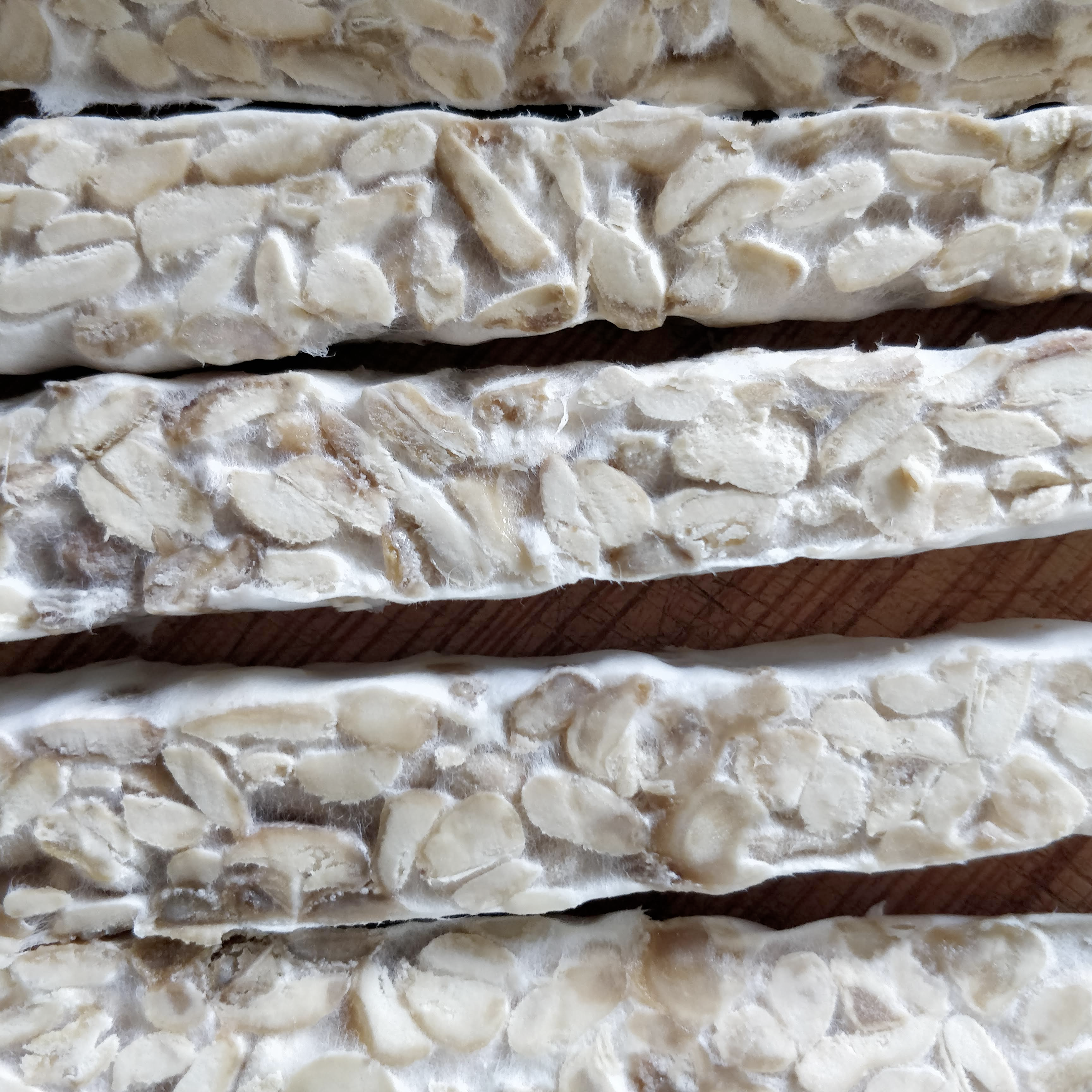
Fava beans: Slightly cheesy smell. Plastic: Bit wet and some bigger beans are exposed and touching the plastic and they got sticky-shiny and smell cheesy
—> dry the beans better next time and cook less!Cut structure is not bad, but there are wet beans visible that turned brown and funky. Throw away. Open: Irregular surface of beans with some fluffy mycelium growing up, some sporulation. When cut quite crumbly, because beans are quite big. Spores are also inside, probably because of air pockets—> press better together and maybe cover with something. Also chop a bit smaller next time.Smell of open sample not unpleasant, so the smell comes really from the exposed beans-on-wet-plastic in the plastic bag sample.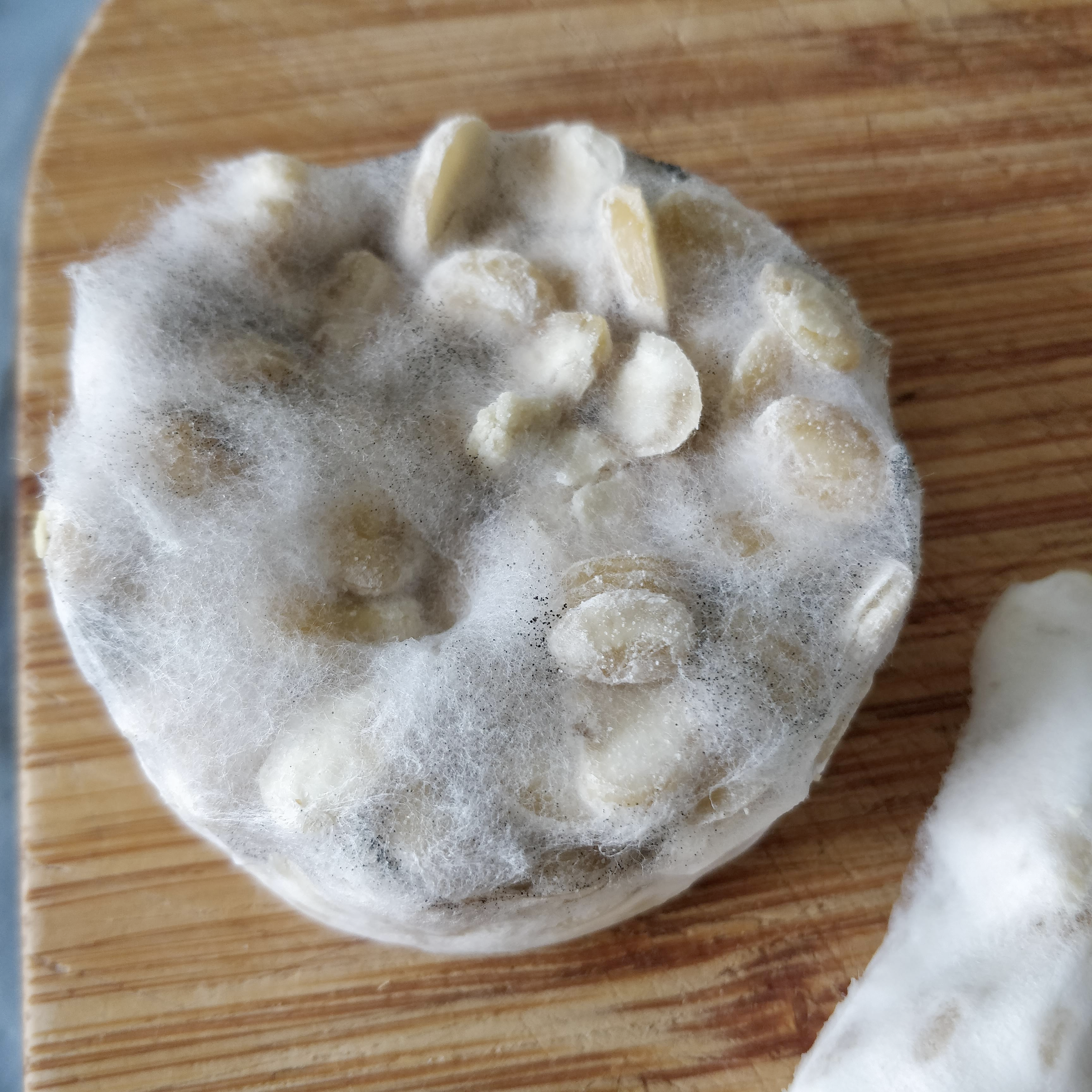
-
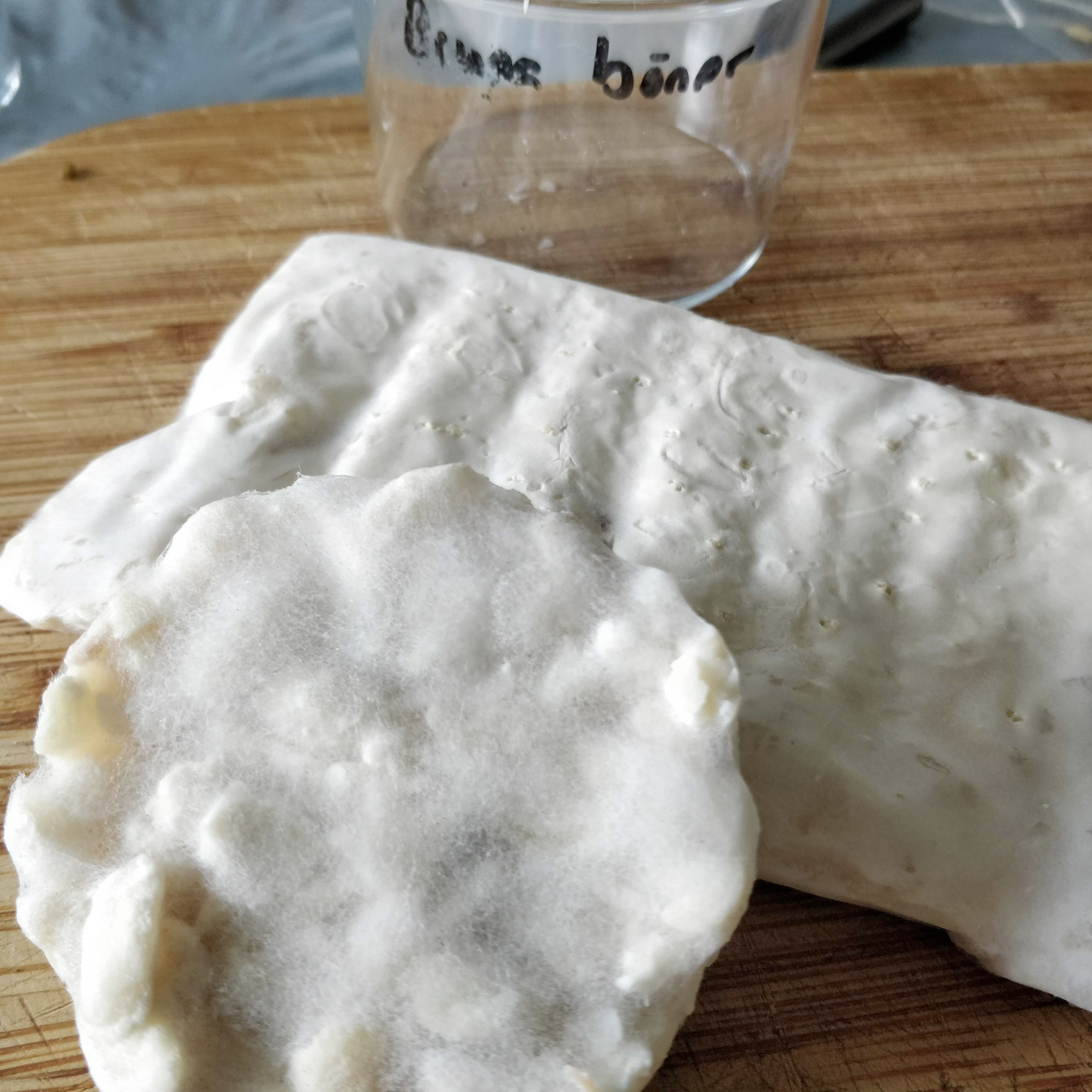
Brown beans: Plastic: Nice very white, dense block. Slight ammonia smell! Or slightly sour smell Not as unpleasant as the lentils and the quinoa. Smells fresher. Open: No ammonia smell, just fresh, almost grassy. Beans are a bit loose and irregular on the top, mycelium fluffy but no spores. Both: No unpleasant smell inside when cut at all. Very mild and neutral. Beans are very white. Good block, holding together well. Not wet, no air pockets.

-
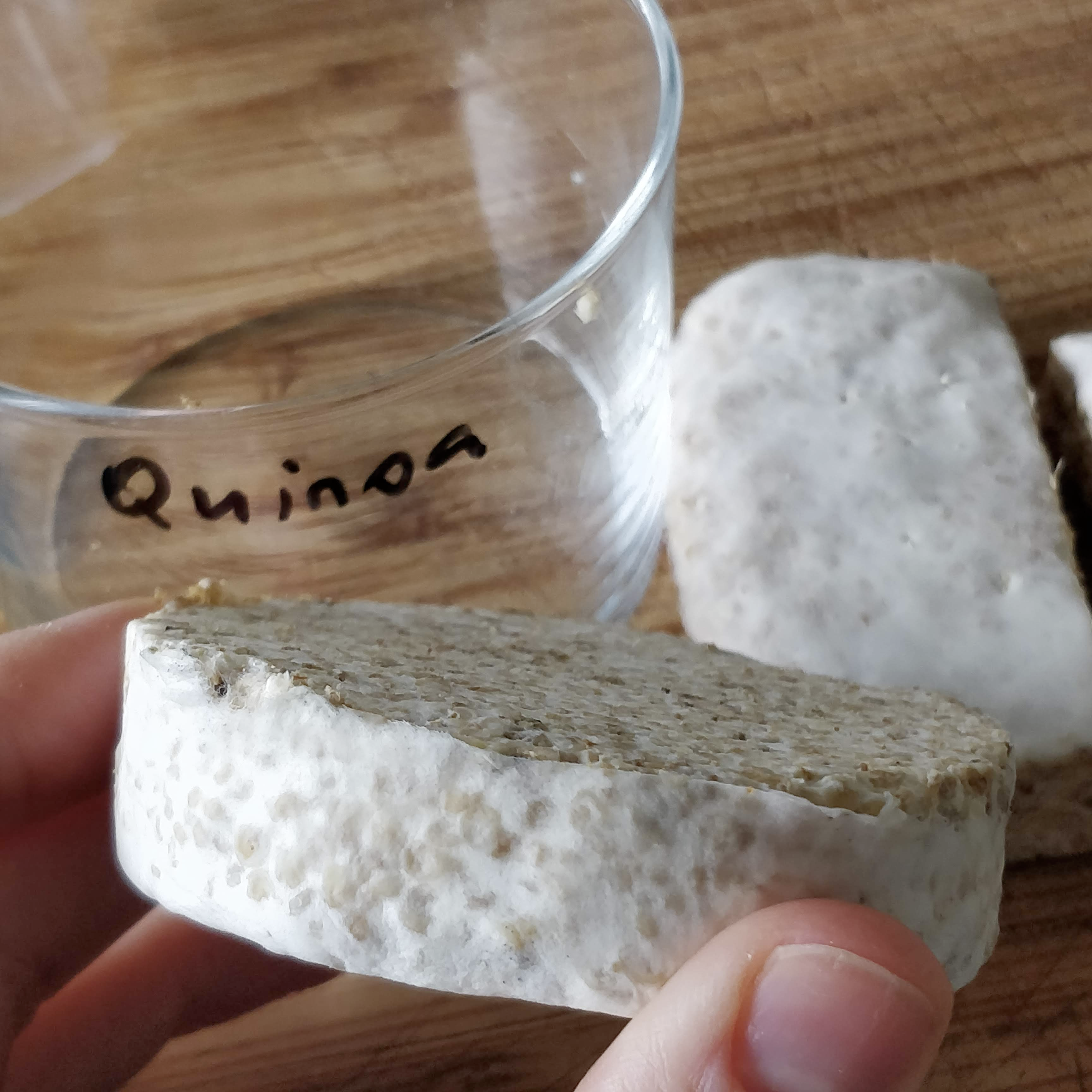
White quinoa: Got the hottest and developed mycelium the fastest. The open incubation even started sporulating (not the case for any other substrates). Plastic: Big non-mycelium spot in the middle with unpleasant smell and colour. It’s sticky and slimy —> remove!
—> Dry the grains more and mix with something bigger to avoid too dense cake.The nice parts have a slighly animal and rotten smell, not entirely pleasant. Nice dense cake in most parts, but e.g. the corners of the plastic bag are not as dense and a bit wet and smell more sharp (ethanol, ammonia). Open: Nice, dense cake, but a lot of fluffy, sporulating mycelium on top—> incubate for a shorter time!Smell of open is less unpleasant and more mushroomy than the plastic bag—> Maybe quinoa needs a LOT of air.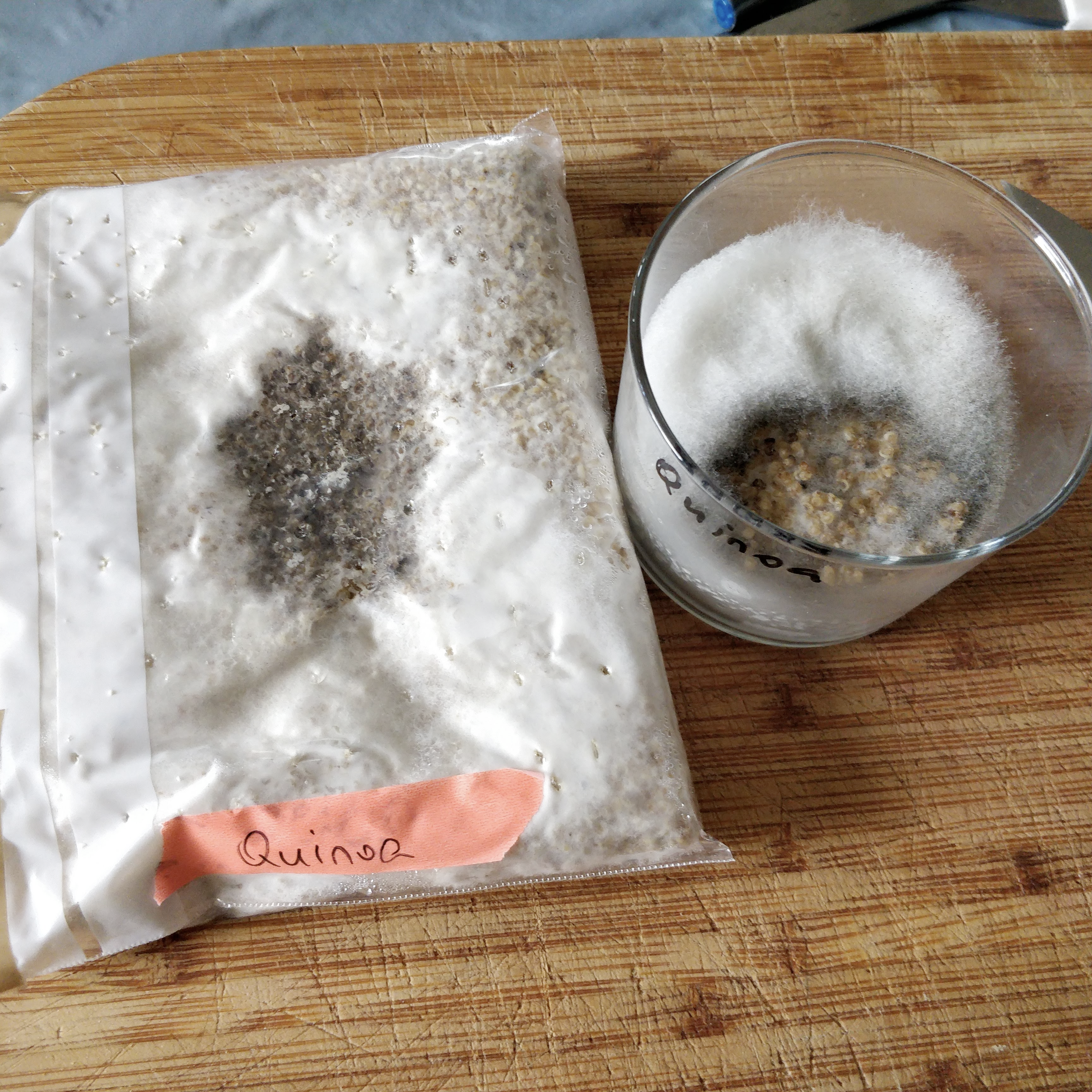
-
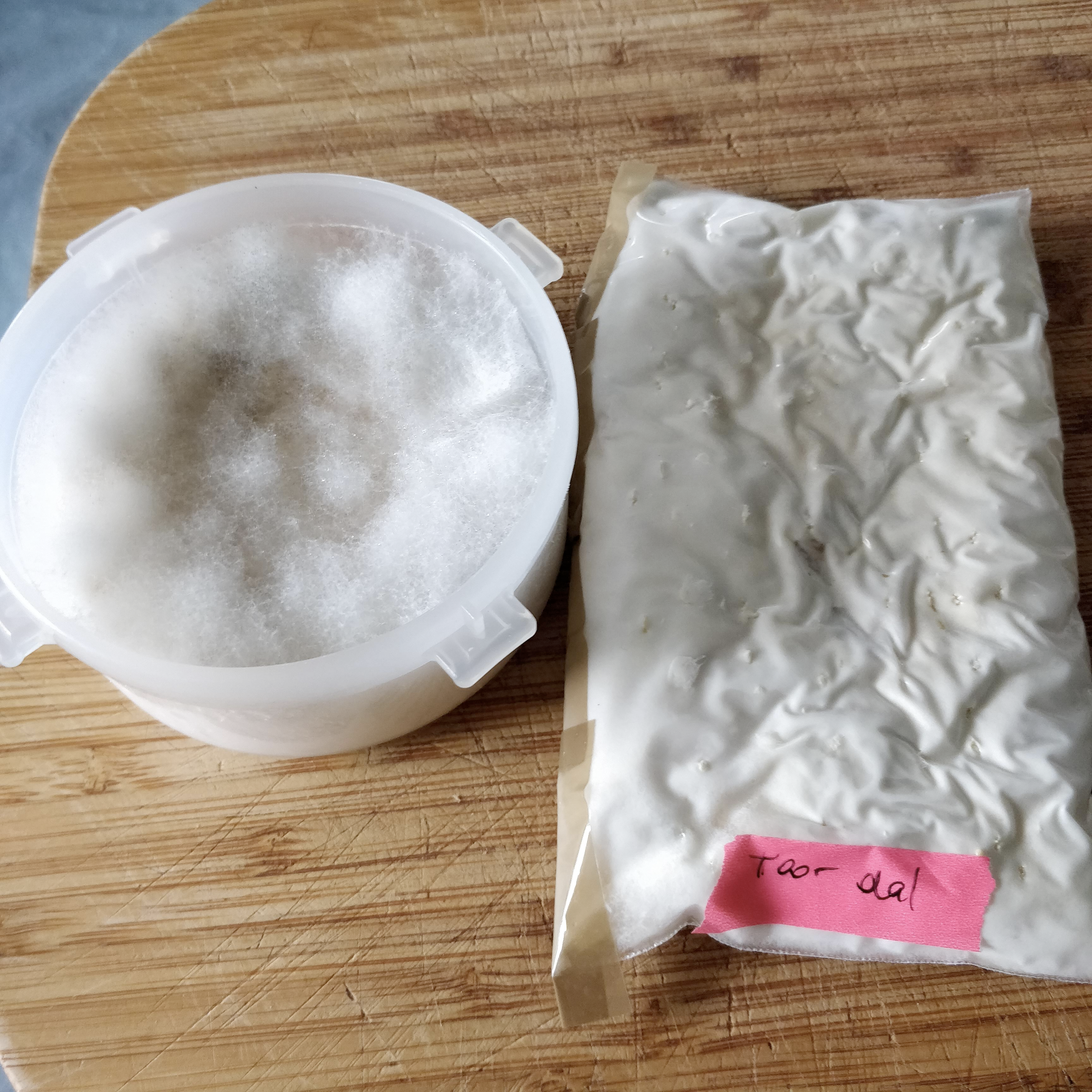
Toor dal: Plastic. Very nice dense cake with thick, smooth, white mycelium all around. Open: Fluffy top with slight sporulation, otherwise similar density to plastic. Both: Smells of almost nothing, very mild. Nice mycelium throughout, no wet or non-grown spots. Perfect tempeh.
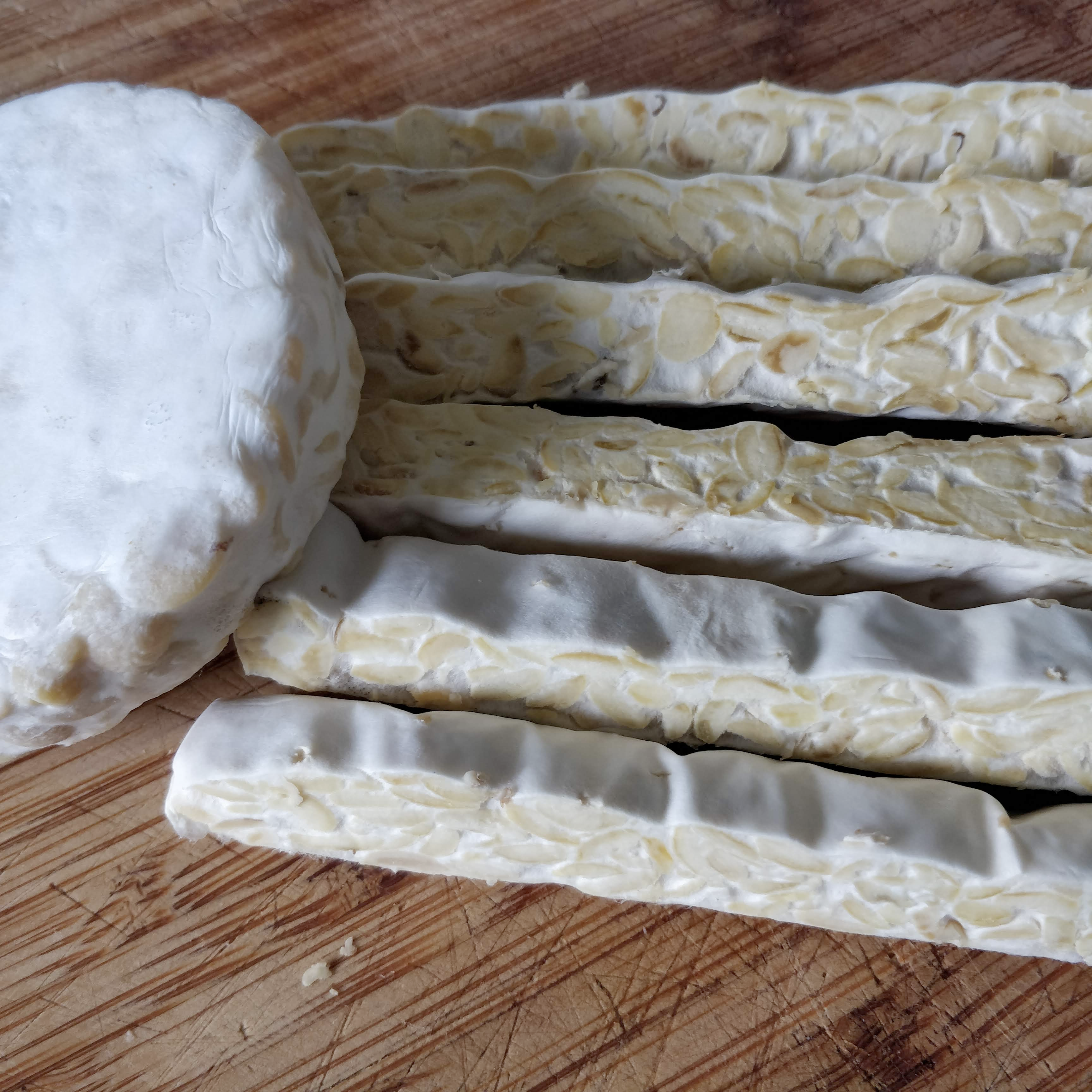
Cooking
Fava beans + additions (2020-09-30)
Test: Addition of things that give more texture to Fava bean tempeh: Sunflower seeds, sesame seeds.
Recipe from tempeh.info: Soy+sunflower seeds: normal soy tempeh, but substitute 100-200 g of beans with sunflower seeds. No soaking, just add them at the start of the bean cooking process. Soy + sesame: Roast 50 g sesame seeds until brown. Mix with cooled, cooked beans.
-
Material: 220 g dry favabeans.
-
Soaking and cooking: No soaking, cook for 20 min until al dente (377 g after cooking).
-
Inoculation: Steam out, add 1 Tbsp vinegar (4 Tbsp/kg) and after cooling 1/2 tsp Topcultures starter (2 tsp/kg).
-
Material: 40 g dry Gotland lentils.
-
Soaking and cooking: No soaking, cook for 12 min (72 g after cooking).
-
Material: 36 g dry sunflower seeds.
-
Soaking and cooking: No soaking, cook for 5 min (49 g after cooking).
-
Material: 29 g (3 Tbsp) toasted white sesame seeds
Combinations
- 125 g cooked fava beans + 29 g toasted sesame seeds.
- 125 g cooked fava beans + 49 g cooked sunflower seeds
- 125 g cooked fava beans + 72 g cooked Gotland lentils
Mix well, fill into take away tubs, press a bit down (cakes are not very high, maybe 1-2 cm), but lid on loosely, incubate above the fridge. Not very warm up there, around 27°C (18:00).
NB: The sesame seed mix developed immediately a very strong sulfurous smell (poopy). That dissipated after a few hours of incubation.
24h: Not very colonised yet, leave in cupboard. Condensation on underside of lid.
37h: Tubs feel very warm on the underside, so take out of cupboard and leave on kitchen table at RT. Starting to get nicely colonised. Bumpy uneven surface because of big beans. Flip the cakes to get a more even surface and avoid too much fluffy mycelium on the top. The underside is a bit wet from condensation in the tub.
63h. Harvest. The sesame mix has slightly started to sporulate in the corner. Nicely colonised, but not super dense mycelium. The beans and seeds are very dense. Sesame seeds are very much collected on the bottom of the tub. Smell is good for all of them, nothing unpleasant or alcoholic.
-
Fava beans + Toasted sesame seeds: Slightly bitter. Sesame taste comes through a little bit, but not too strong.
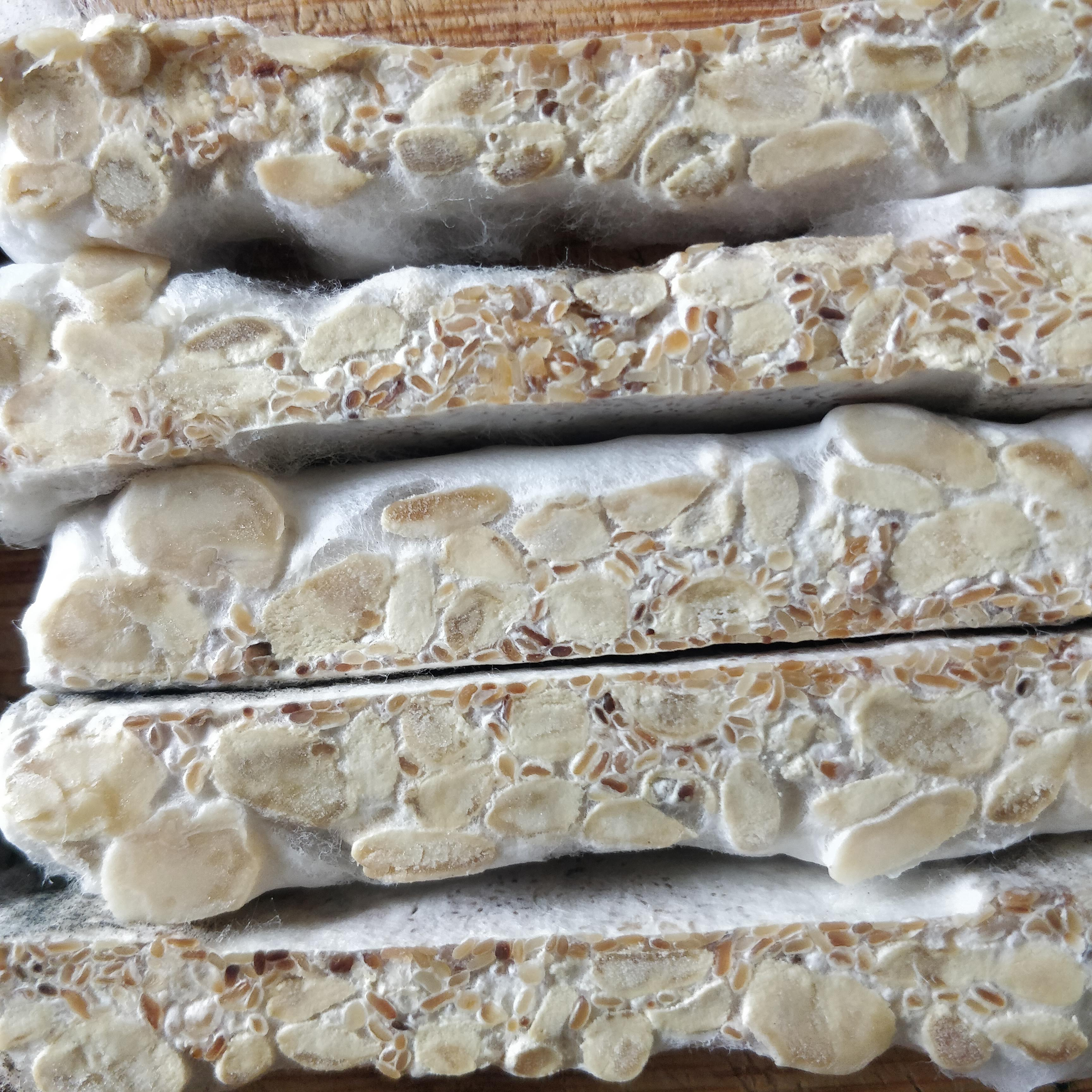
-
Fava beans + Sunflower seeds: Bit nutty.
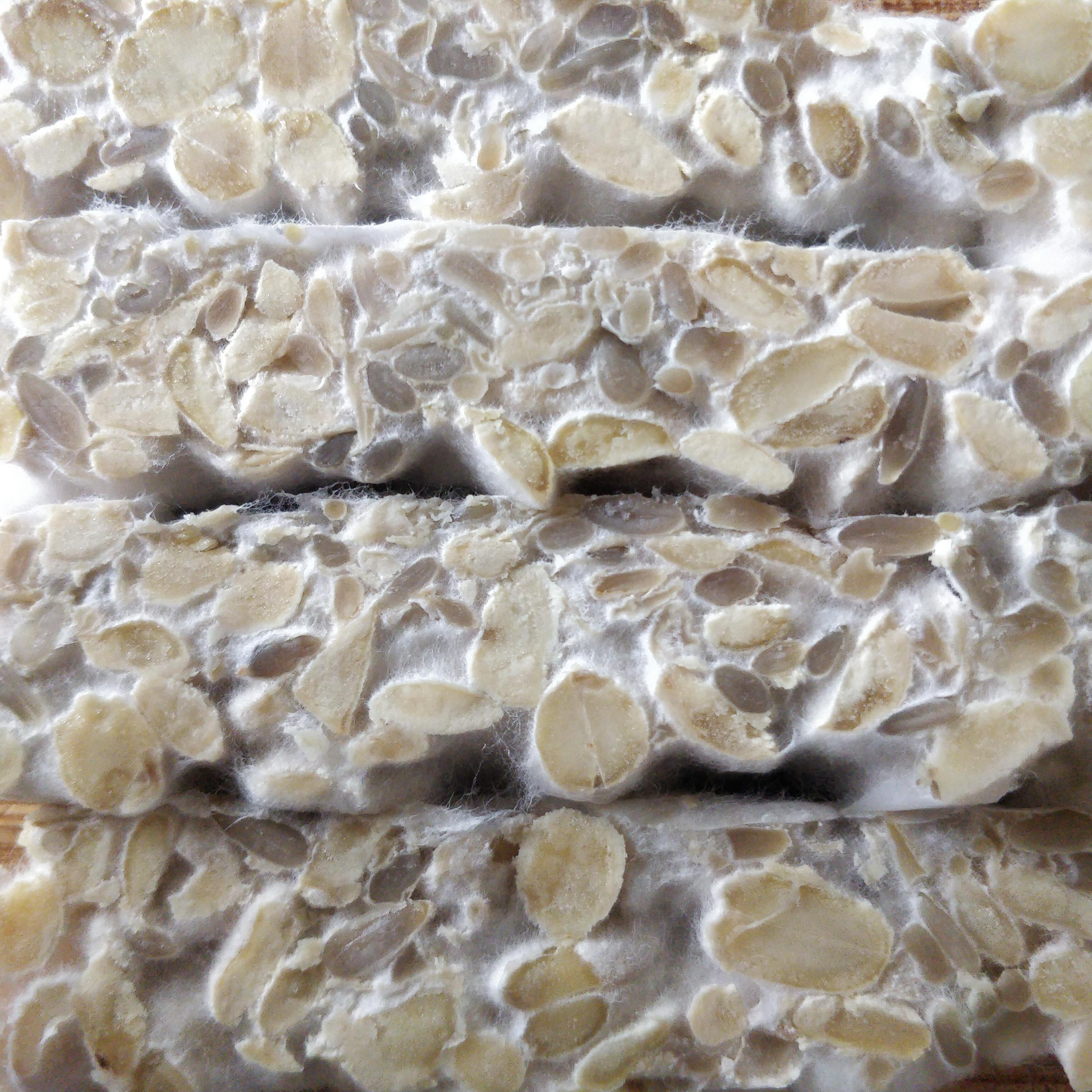
-
Fava beans + Gotland lentils: Embedded lentils are nice since they stay intact; the rest is nicely chewy. Nice texture. Winner! (Although when tempeh is being boiled, the lentils tend to fall out quite a lot)
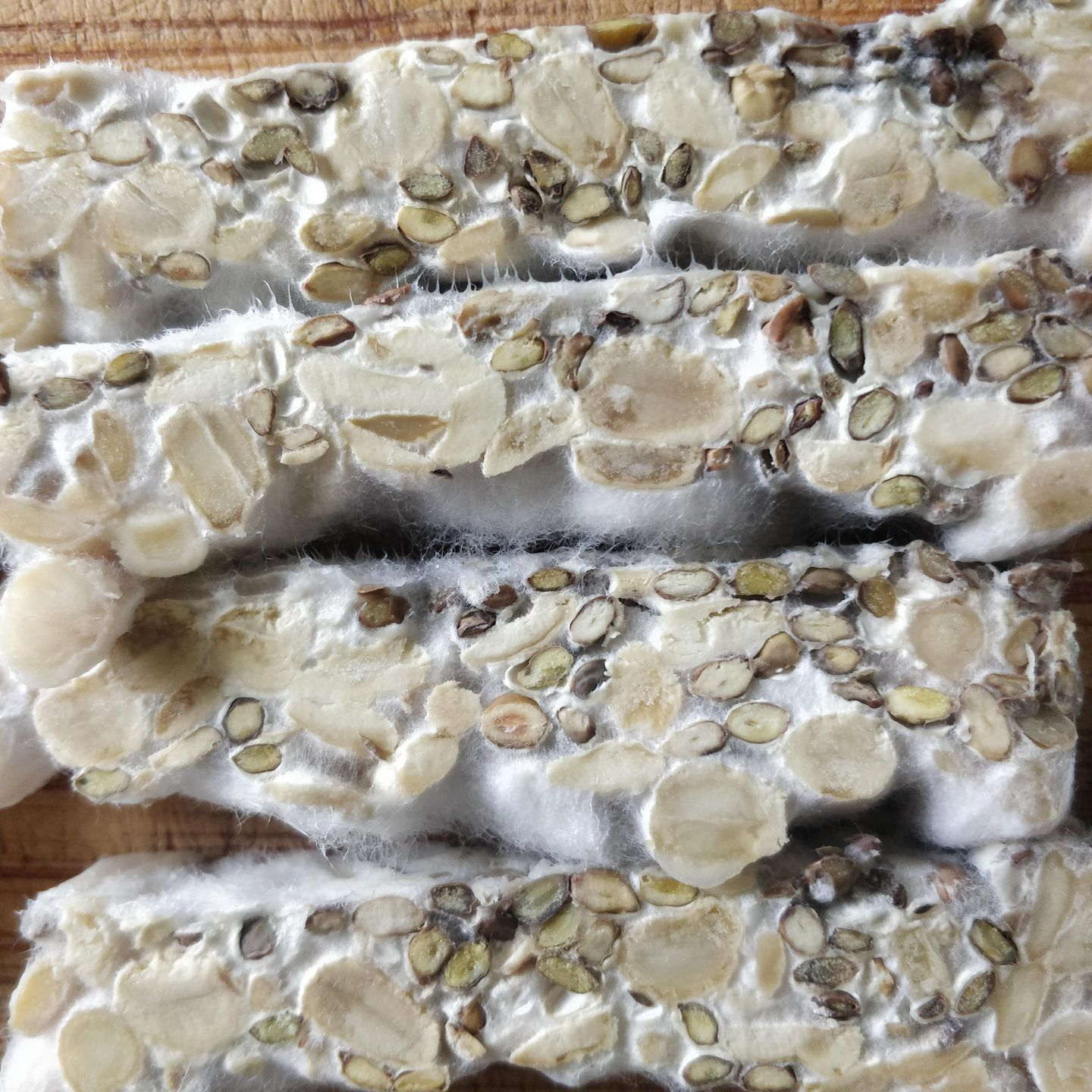
Test starter cultures - LUVI vs. Topcultures (2020-10-07)
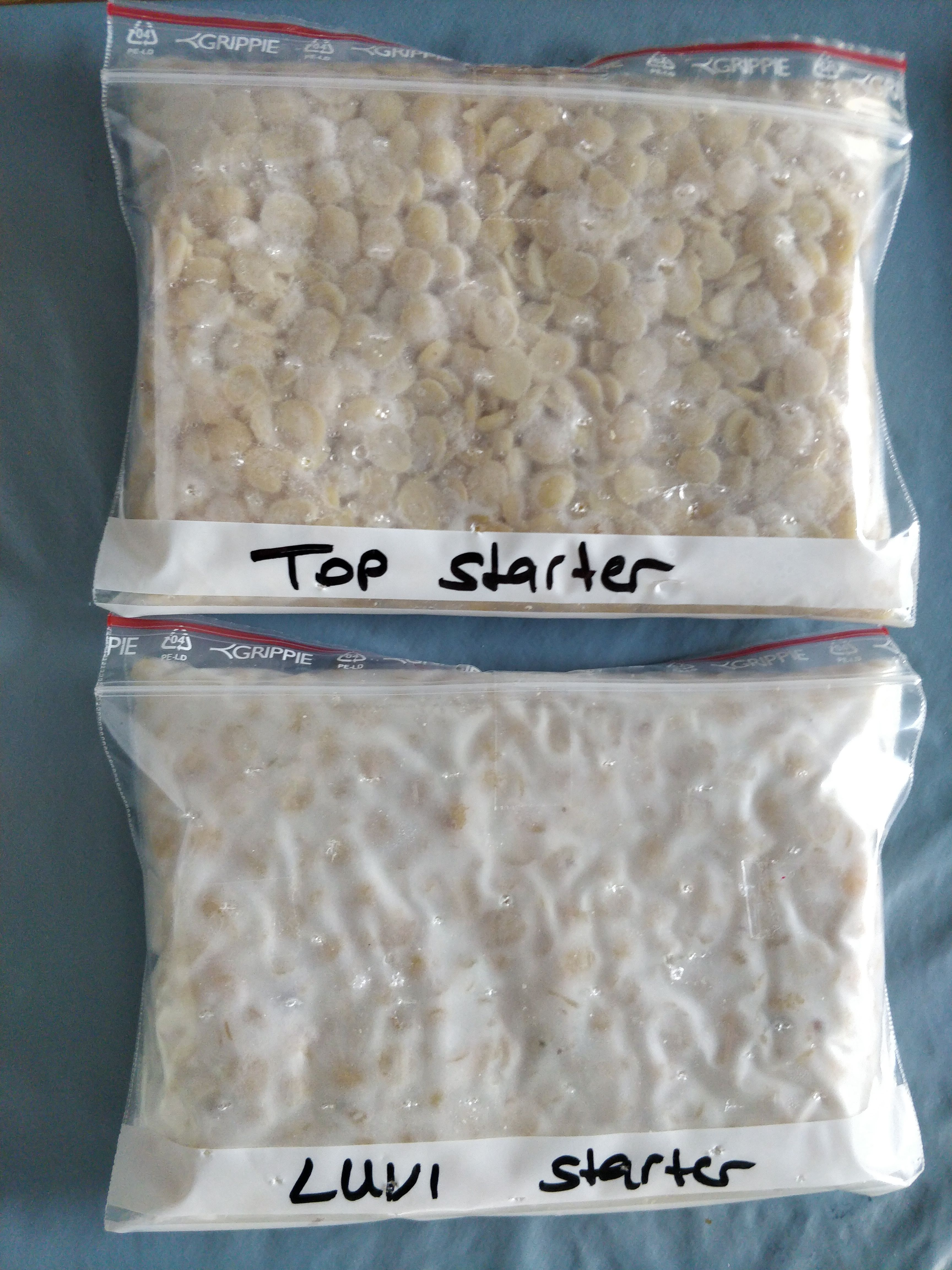
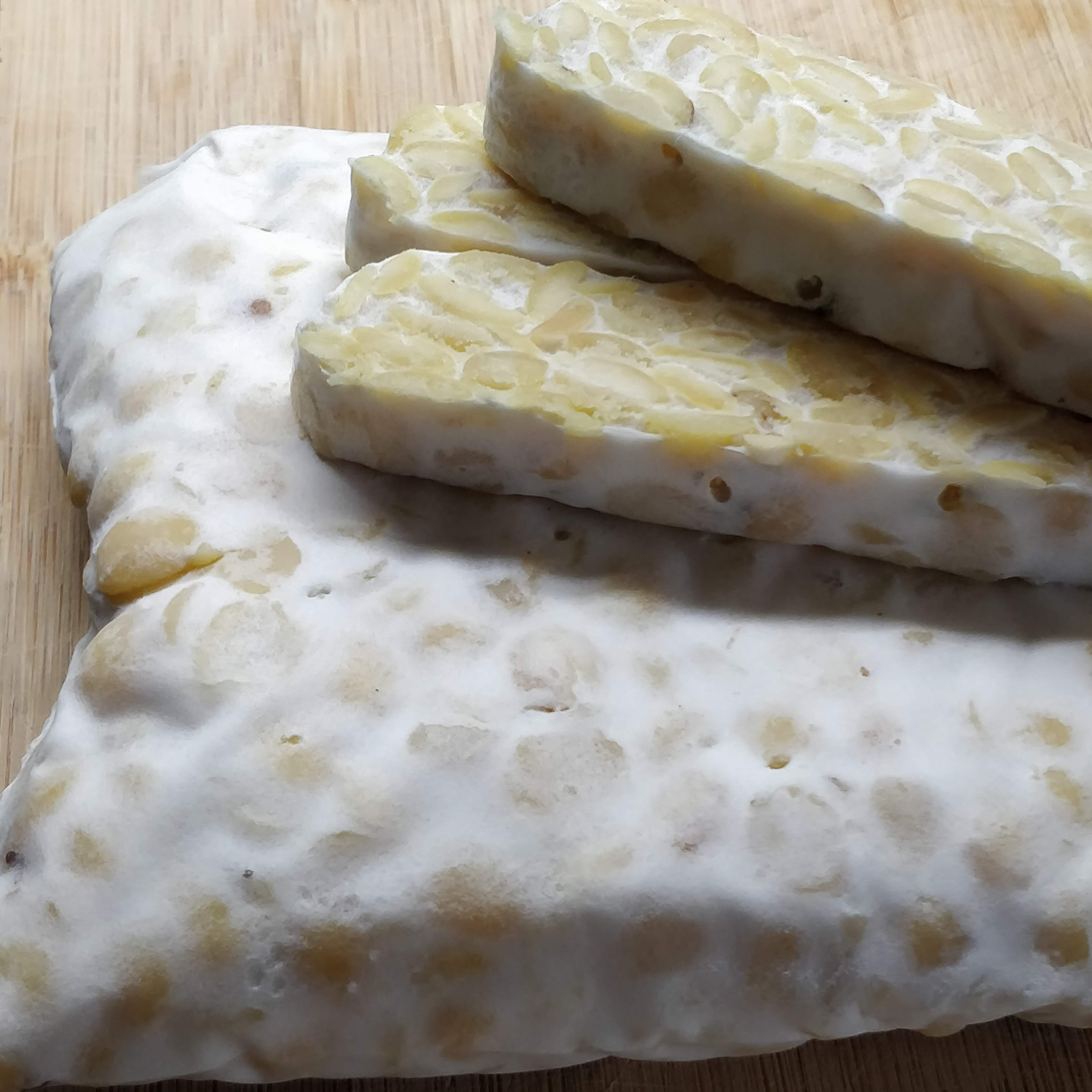
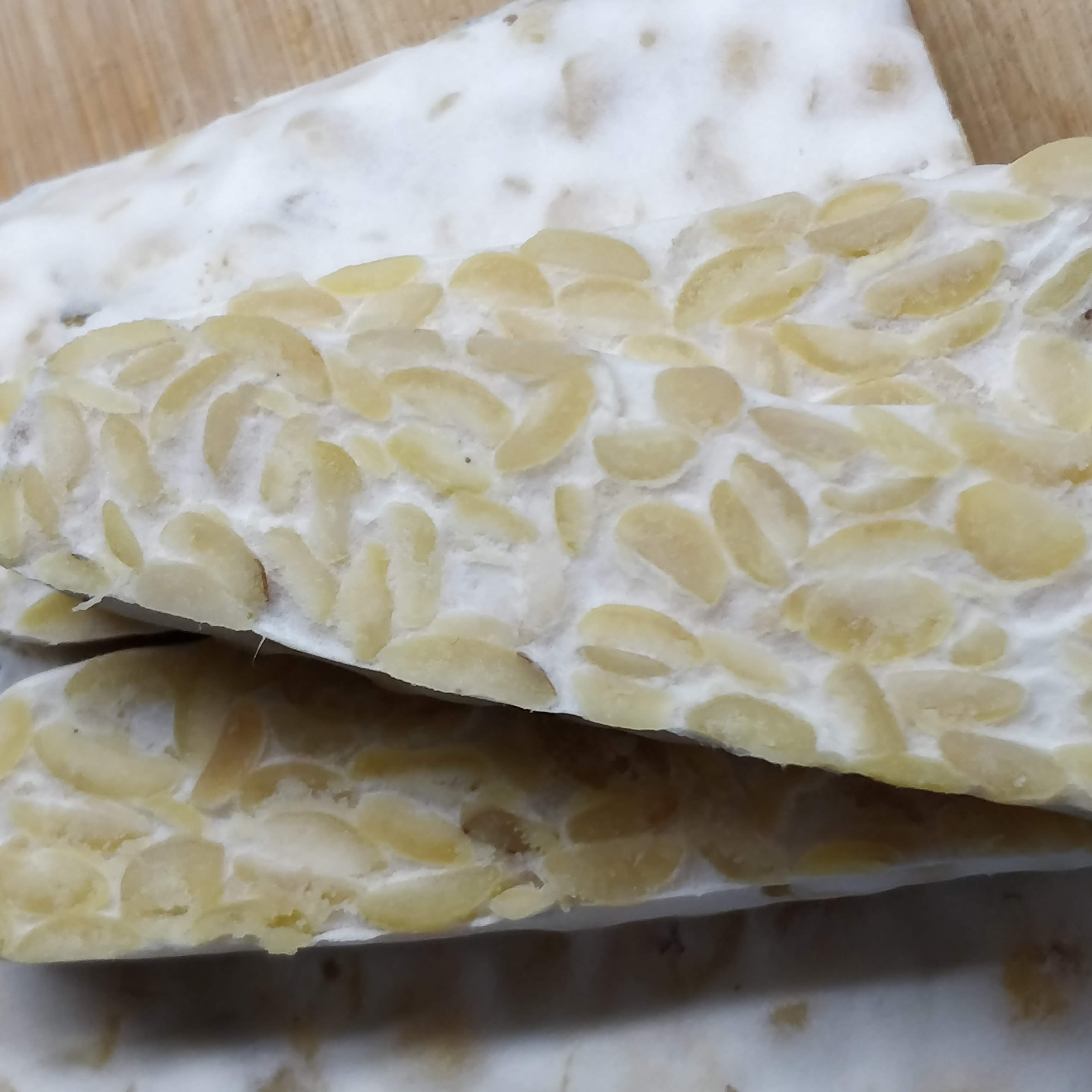
250g Toor dal, soak o/n, then cook for 10 min, drain. Add 1 Tbsp apple cider vinegar (4 Tbsp/kg), dry at 30°C in oven for 30 min, then divide into 2 parts (500 g cooked beans in total). Add 1/4 tsp (1 tsp/kg) starter, mix and incubate in perforated bags in oven at 30°C. 1) Topcultures, 2) LUVI starter.
16.5h: Topcultures (34°C) nothing visible yet, LUVI (32°C) is already starting to get white and fluffy.
18.5h: Topcultures (38°C), LUVI (36°C). Open door and leave on tray.
29.5h: Topcultures: Not dense enough, leave in turned-off oven for another 12h (o/n). LUVI is sufficiently grown and smells nice (mild and slightly fruity) —> put in fridge.
40h: Topcultures is now also colonised, but not as much as the LUVI sample.
Conclusions
The Topcultures starter must have lost quite a lot of activity while stored at RT, from now on store all starter in the fridge (or freezer if larger batch)!
Unfortunately I stored the tempeh samples untreated in the fridge for 6 days and then they were DISGUSTING! They cannot be stored untreated for that long!! 3 days is probably the absolute maximum, so either heat-treat or freeze samples after incubation! I had to throw it away.
Heat-treated vs. untreated toor dal tempeh
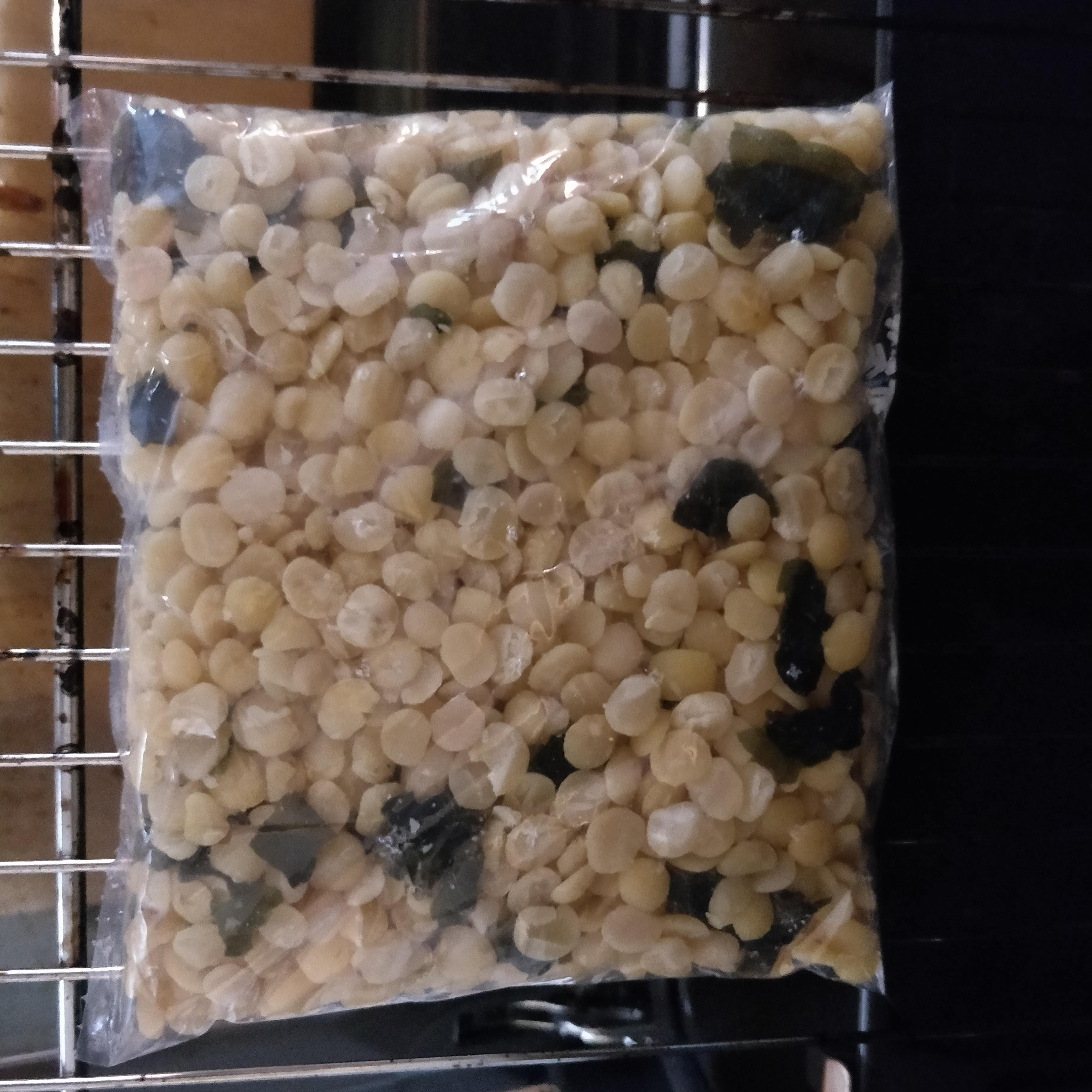
250g Toor dal, soak o/n, then boil for 7 min. Drain, add 1 Tbsp apple cider vinegar (4 Tbsp/kg), let dry in oven at 30°C. Add 1/2 tsp LUVI starter (2 tsp/kg), mix. 1 bag: only Toor dal, 1 bag: a bit of ripped apart sockertång dispersed in the dal. Incubate in oven at 30°C.
21h: Stop incubation, they are densely colonised. There is a tiny bit of sporulation starting around some of the holes. Both samples are colonies nicely, but the seaweed is kind of just sitting on top of the beans. There’s no seaweed inside. On the surface, the seaweed feels a bit sticky/slimey.
Cut in half and freeze one half immediately. Heat-treat the other half by wrapping in aluminium foil and baking in a 85°C oven for 30 min. Then leave on the counter a bit to cool, put in a tub and store in the fridge.
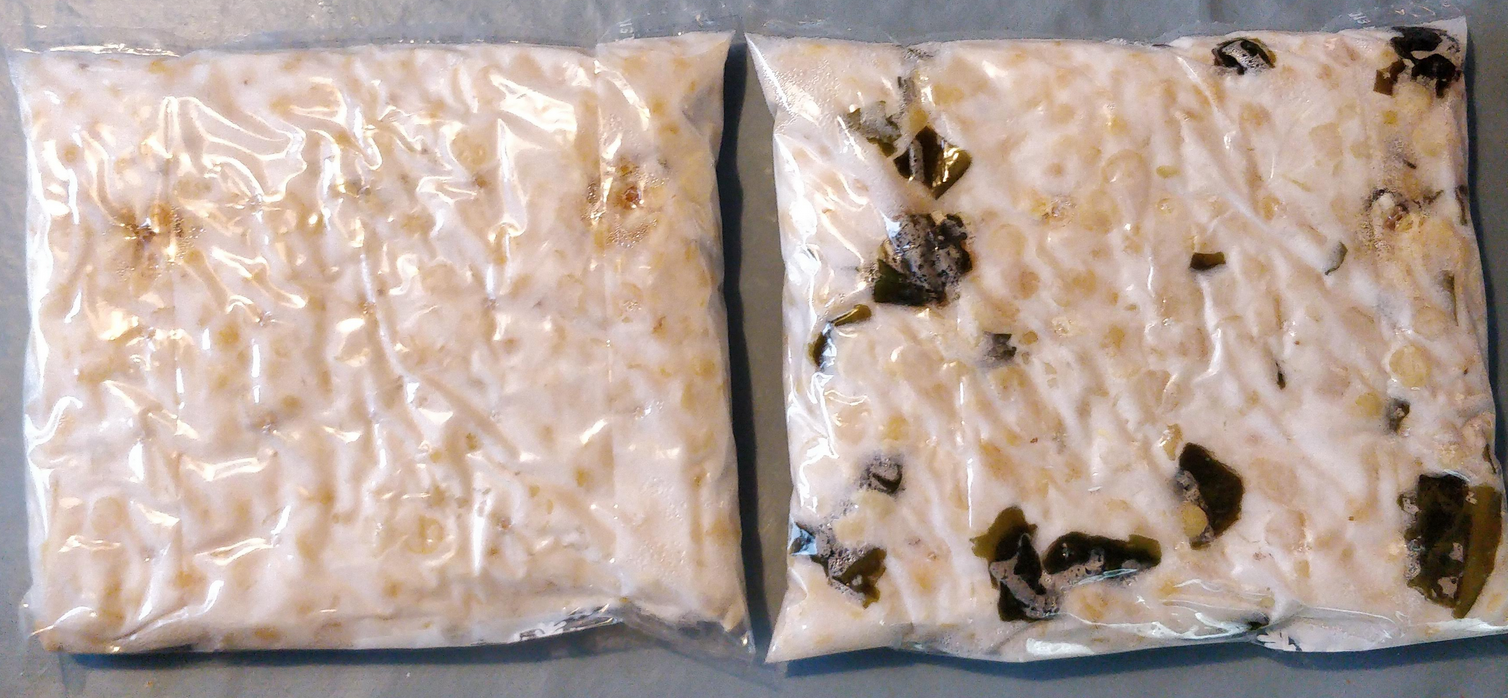


Cook 8 days later:
Split into 4 pieces, let thaw (if frozen). No visual difference between frozen and heat-treated tempeh (other than that the not heat-treated one is slightly whiter). Slight difference in smell: frozen & thawed has fresh mushroomy smell, the heat-treated one smells mild and slightly stale.
For details of cooking experiment, see Boiled vs. non-boiled - toor dal and black bean tempeh
Black bean + fava bean mix
250g favabeans and 125g black beans; soak separately o/n. Black beans: chop in food processor after soaking to about 1/3-1/4 of original size (though some remain whole!). Cook for 2 min, drain. Favabeans: Cook for 2 min, drain.
Mix both beans together, add 1.5 Tbsp vinegar (4 Tbsp/kg), mix, spread on baking tray, let dry in 30°C oven, stir ocassionally. Add 1/2 tsp LUVI starter (2 tsp/kg) and incubate in perforated bags in oven at 30°C.
21h: Turn off oven, leave for another 3h.
24h: Harvest. Freeze one half immediately, heat-treat the other half immediately by wrapping in aluminium foil and baking at 85°C for 30 min, then cool down and store in fridge.
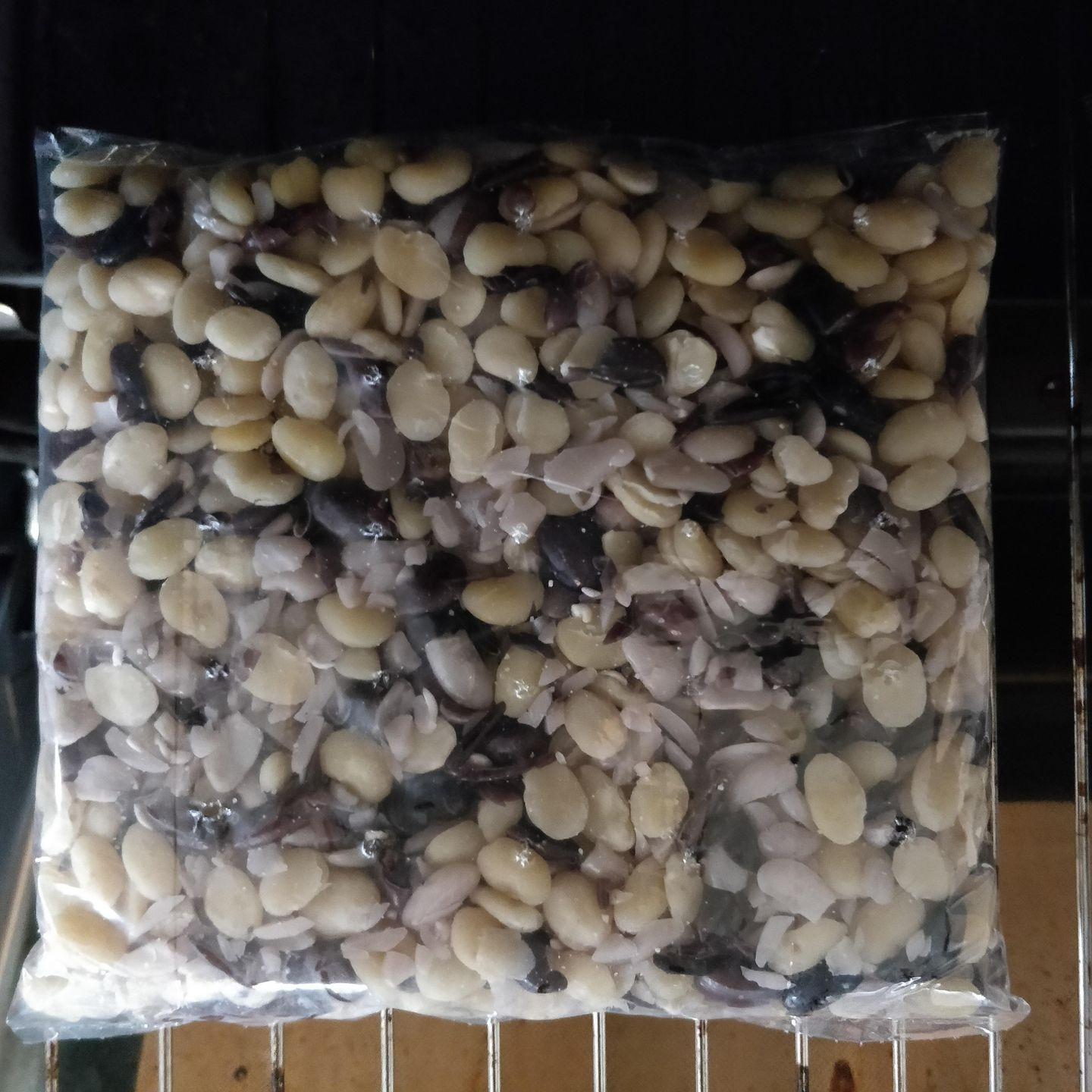
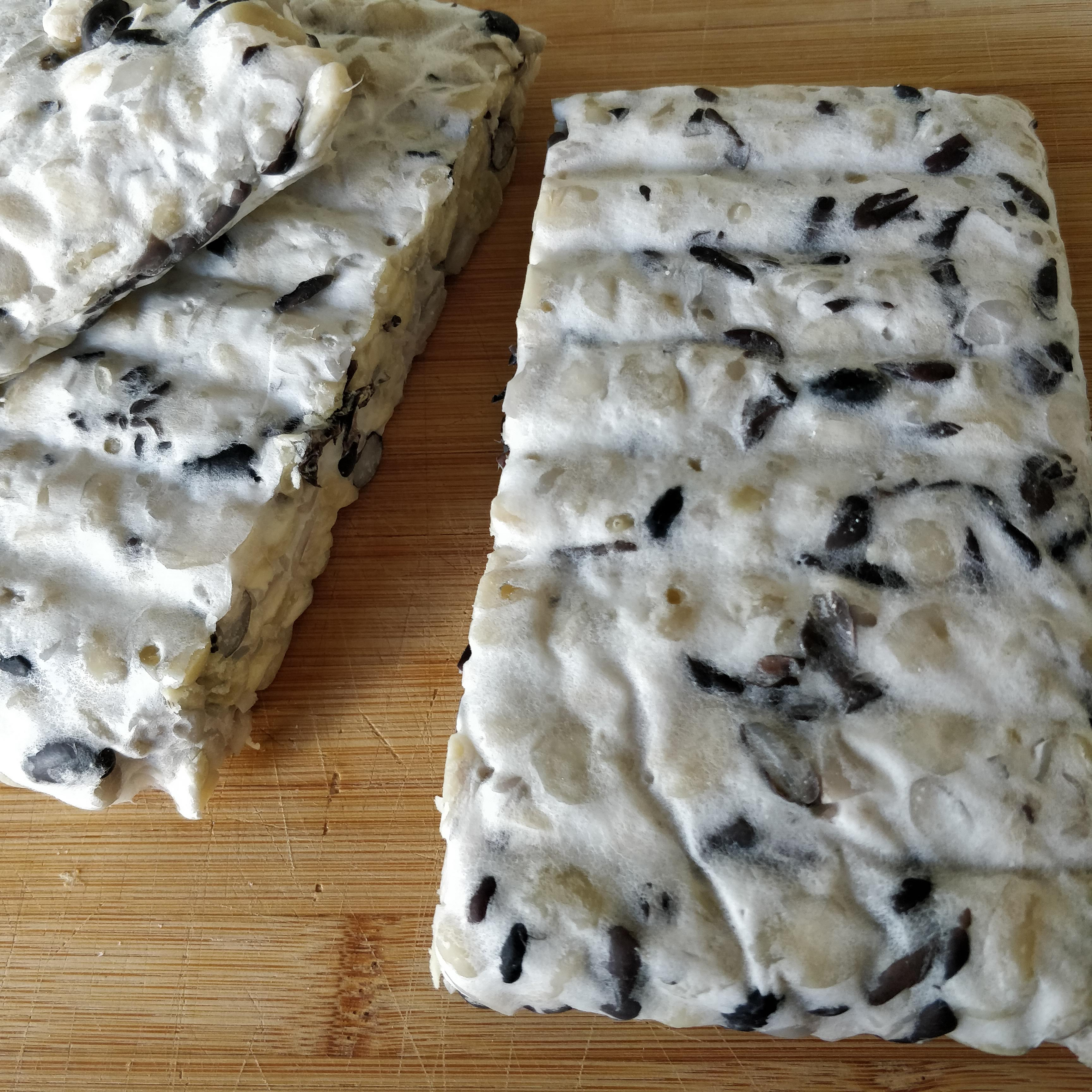
Conclusions: Good tempeh! No off notes at all. Very little sporulation, very good and fast mycelium growth. However, because of the relatively short incubation time, it tastes quite “fresh” and beany/starchy. Not chewy at all. Could be due to shorter time, more or less cooked beans, heat treatment or lack of boiling in soy-water.
Cook 8 days later:
For details of cooking experiment, see Boiled vs. non-boiled - toor dal and black bean tempeh
Fava beans + Gotland lentils - different incubation times (2020-10-28)
200g favabeans, soak in cold water for 5h, then cook for 2.5 min.
57g Gotlandslinser, no soaking, cook for 12 min.
Drain, mix, spread on baking tray. Add 1 Tbsp apple cider vinegar (4 Tbsp/kg), let evaporate at 30°C. Add 1/2 tsp LUVI starter (2 tsp/kg), mix, incubate.
Harvest at 24h, 36h and 48h. Store in fridge (untreated) for 1 day. Then proceed with cooking.
Boil each sample 2x2 min in 200 mL water + 30 mL light soy sauce (= half strength of what I normally use). Dry on rack and store in fridge over night.
Fry and taste.
24h incubation samples: Quite fragile, falls apart a bit. Not very bound. Quite starchy. Nice flavour. Bit crumbly. Maybe a crumbly topping? The lentils got nicely crunchy and are distinct inside the favabeans.
36h incubation samples: Holds together better than 24h sample. Definitely a bit of a fermented taste. Looks very attractive with the embedded lentils. Could be more flavoured, the 1/2 concentrated soy-water mix is not as good as the normal one.
48h incubation samples: Browns the best. Nice flavours, a bit more interesting. Bit dry and the fried lentils on the surface got quite (too?) crunchy.
Conclusions
Overall, 24h sample falls apart too much and doesn’t really taste of tempeh, just of lentils and beans. 36h and 48h are very close with 48h being slightly better. 36h tastes of several things, whereas 48h has a more rounded flavour profile. Both have kept a “healthy” tasting texture, i.e. more beans and lentils than meaty. Interesting since I’m sure earlier tempeh trials that resulted in very chewy-juicy tempeh were also incubated for 36-48h. Must be either the starter, the beans (e.g. soybeans) or the “suboptimal” incubation conditions in the fridge cupboard that cause the different texture. Both the 36h and 48h ones would be suitable for restaurants, whereas e.g. for a burger you’d want something chewier and juicier.
Run some more trials with different conditions and beans to see when I get a juicier texture vs. a beanier-healthier texture.
Black eyed beans & black beans (2020-11-05)
Soak for 24h: 125g black eyed beans, 125g black beans (from Fram).
Black-eyed beans
Use as they are, don’t try to dehull. Change water and cook for 5 min, then they are nicely done (almost too much maybe). Drain, add 0.5 Tbsp vinegar (4 Tbsp/kg), let dry in oven at 40°C. Mix in 1/4 tsp LUVI starter (2 tsp/kg), fill in bag and incubate in oven at 30°C (start: 21:00). Turn off oven at 22:00 (after 25h) and leave at RT until 12:00. Total incubation: 39h.
Very loose cake, falls apart when I try to lift it since the mycelium is not strong enough to hold the whole beans together. Would’ve been probably better to chop the beans a bit, and the skin is possibly also too tough for the fungus to penetrate properly. It also looks a bit unpleasant, since the black spots look like spore formation through the white mycelium.
Black beans
Chop in food processor, 2-3 pulses. Rinse and boil for 2 min. (I could’ve probably treated the black beans like the black-eyed beans, i.e. not chopping or dehulling, and cooking for 5 min). Drain, add 0.5 Tbsp vinegar (4 Tbsp/kg), let dry in oven at 40°C. Mix in 1/4 tsp LUVI starter (2 tsp/kg), fill in bag and incubate in oven at 30°C (start: 21:00). Turn off oven at 22:00 (after 25h) and leave at RT until 12:00. Total incubation: 39h.
Quite loose cake, not as loose as the black eyed peas, but almost. Falls apart when boiling in soy water. The chopping helped to have the mycelium grow better, but it’s still not strong enough to hold the mostly whole beans together. Looks good with the black skins though.
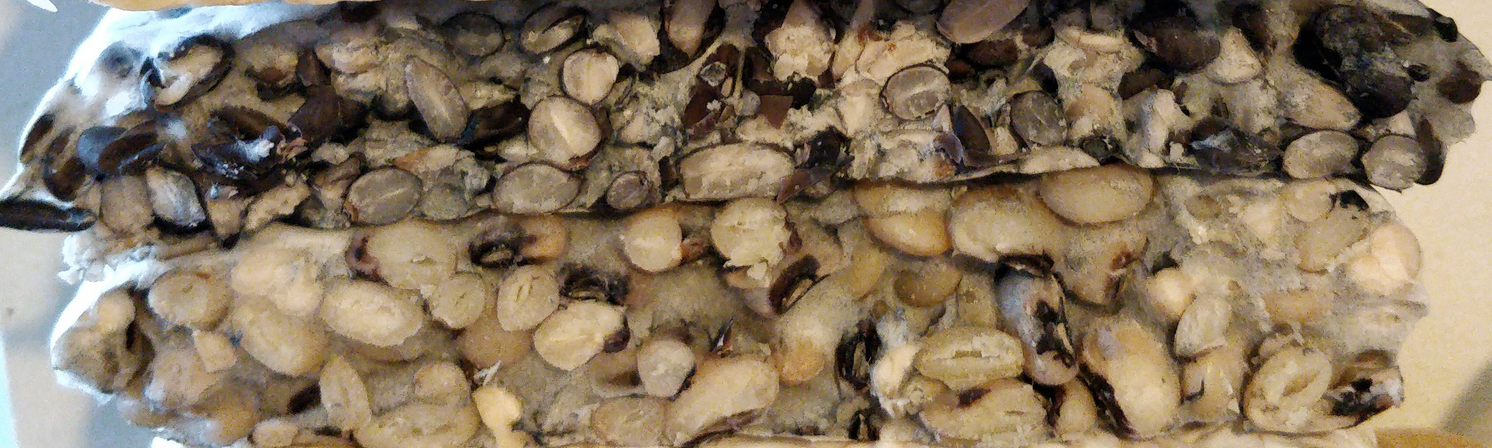
The chopping doesn't really remove the hulls at all and just an irregular picture. However, the whole beans (black eyed beans) were not penetrated well by the mycelium and the cake was very loose. Therefore, chopping might be necessary for bigger beans with a tough skin.
Freeze half, heat-treat the other half (wrapped in aluminium foil, 85°C for 30 min in the oven). Boiling in 200 mL water + 60 mL light soy sauce for 2 min on each side. The two other bean cakes crumble completely (esp. the black eyed beans one). Store in fridge until use.
Retry black bean tempeh with more cooking, like in this recipe and also with longer incubation time (48h):
https://fullofplants.com/black-bean-tempeh-soy-free/
Cooking:
The two black bean tempehs were too crumbly to fry in one piece, so they were crumbled into a pan with oil and fried. This basically resulted in beans flavoured with soy sauce being fried. There was not much tempeh taste or feeling. They were a bit starchy, but tasty, especially with some sauce. We ate it in tortillas.
Black beans + toor dal, 3 different starters (2020-11-12)
Test LUVI, Topcultures and Raprima starters.
Toor dal 180g, rinse and soak o/n, cook for 10 min. The beans are quite soft, probably overcooked —> mix with the black beans to balance that. Drain and let cool down, add a bit less than 1 Tbsp apple cider vinegar (4 Tbsp/kg) and mix.
Black beans 250g, rinse and soak o/n, cook for 45 min. Drain and let cool down. Add 1 Tbsp apple cider vinegar (4 Tbsp/kg) and squash some beans with a fork to create some easily available starch for the fungi colonisation.
Mix the two beans and make 3 portions:
300g + 1/4 tsp LUVI starter, 300g + 1/2 tsp Topcultures starter (because I know it has lost activity), 240g + 1/4 tsp Raprima starter (just arrived, stored in freezer).
Incubate in the oven at 32°C, start 17:00. Turn off oven from 21:00-9:00. 32°C from 9:00-21:00, then off oven over night.
LUVI grows fastest, very dense cake after 24h. Raprima only slightly less dense. Topcultures is lagging behind and not very dense yet after 24h.
Harvest LUVI and Raprima at 9:00 (40h) and Topcultures at 20:00 (51h). LUVI and Topcultures: 285g, Raprima 230g.

Store in fridge until the next day, then heat treat at 85c for 30 min.

Smell of LUVI and Raprima is mild and very slightly alcoholic or yeasty, whereas Topcultures is a bit off and musty. Topcultures also has a few patches of bad growth.
Cooking:
Cut half of each cake into thick slices and boil in 400 mL water + 60 mL light soy sauce for 10 min. The other half, boil as a whole block. The slices soak up the liquid very well, but the block is not penetrated with liquid on the inside. —> When boiling, cut into slices!
Fry the slices and taste.
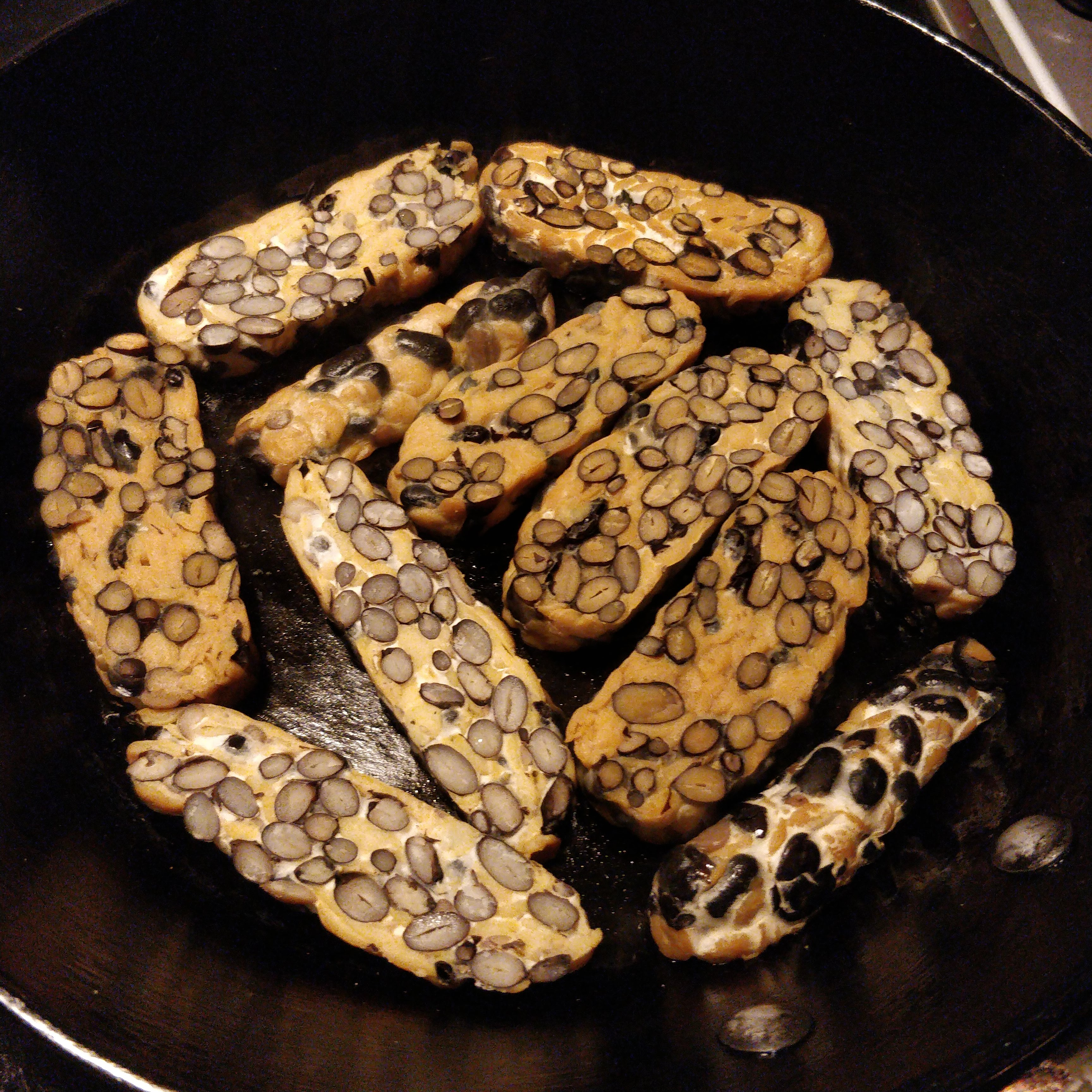
All samples have a very similar consistency: chewy and juicy, but still with some beans inside, but not starchy! Yay! The toor dal has become more like a homogeneous mass that is nicely chewy and the black beans embedded in it give it a nice look and a nice change of texture, since they stayed a bit more beany.
LUVI tastes best, no off flavours, mild notes. Topcultures also tastes nice. However, Raprima has an unpleasant off-flavour! —> Maybe it was over-fermented, or the 32°C were too high?? Test again by keeping everything else exactly the same but with lower temperature and take different time samples. It was quite long fermented (40-50h!), because I turned off the heating during the nights, which is not ideal.
Definitely keep the long cooking time for the black beans and don’t bother chopping or dehulling. However, mash a small part of it with a fork, that definitely helped for growth.
Compare different incubation times (28h & 40h); black beans and Toor dal (2020-11-18)
Toor dal: 90 g, rinse and soak o/n, cook for 10 min. The beans are quite soft, probably overcooked —> mix with the black beans to balance that.
Drain and let cool down, add a bit less than 0.5 Tbsp apple cider vinegar (4 Tbsp/kg) and mix.
Black beans: 125g, rinse and soak o/n, cook for 45 min. Drain and let cool down. Add 0.5 Tbsp apple cider vinegar (4 Tbsp/kg) and squash some beans with a fork to create some easily available starch for the fungi colonisation.
Mix toor dal and black beans together, add 1/4 tsp Raprima starter, fill in bag, incubate at 30°C in the oven. Start: 17:00.
21h: Turn off the oven and let incubate for another 7 hours.
28h: Harvest 2/3 of the block and freeze immediately.
40h: Harvest the rest and freeze immediately.
Both blocks look amazing with dense white mycelium and nicely embedded beans, smell mild and nice, no ammonia smell, uniform. The 40h block has a very thick white mycelium layer all around, no sporulation visible at all.
Fava beans with salt, grey peas (2020-11-24)
Favabeans: Different kind this time, they look rounder and less fragmented. Ville picked them up directly from Marcus (18 SEK/kg). Soak o/n, cook for 4 min. Add 1/2 tsp to the cooking water so that the salt is just about tastable. The cooked beans taste nice and the salt definitely improves the taste. Add 1/2 Tbsp (4 Tbsp/kg) apple cider vinegar and let dry in 30°C oven
Grey peas: From Ville. Soak o/n, cook for 10 min. Add 1/2 Tbsp (4 Tbsp/kg) apple cider vinegar and let dry in 30°C oven. Squash a few peas with a fork to provide starting material for fungus.
Mix each bean portion with 1/4 tsp Raprima starter (2 tsp/kg), then incubate at 30°C in the oven. Start: 13:00.
24h: Favabean cake is nicely dense and has 35°C, so take out of the oven and let incubate at RT for another 5h (=29h). Store in fridge for 2 days. Grey pea cake is still somewhat loose, so incubate for another 24h (=48h). Store in fridge for 1 day.
Conclusion
Favabenas worked really well and they make a nice, slightly chewy tempeh. They salt improved the taste a little bit, but not really enough to make it worth losing a bit of viability. Grey peas didn’t work at all, the tempeh is very loose, barely holds together and in between the peas it has actually started to sporulate. Throw away! —> Salt addition is not really worth it for the taste, better to boil or marinate afterwards. Grey peas don't work at all if they are not dehulled and split!
Red quinoa burgers (2020-11-27)
Red quinoa: Garant, 125g. Wash thoroughly. Boil in 2-3x as much water for 15 min, then drain, add 0.5 Tbsp (4 Tbsp/kg) apple cider vinegar, spread on baking tray, let dry in oven. Add 1/4 tsp Raprima starter (2 tsp/kg), fill into small glass jars. Incubate in 30°C oven.
24h: Turn off the heat, then leave for another 22h (=44h).

Conclusion
Very nice and dense cake. Need a lot of air, so good to incubate in open dish. Turn off heat quite early, it produces a lot of heat.
Toor dal + black bean, Fava bean + black bean (2020-12-01)
Toor dal: 250g, rinse and soak o/n, cook for 10 min. Drain and let cool down, add 1 Tbsp apple cider vinegar (4 Tbsp/kg) and mix. Dry in oven at 30°C. Add 1/2 tsp (2 tsp/kg) of Raprima starter, mix.
Black beans: 250g, rinse and soak o/n, cook for 45 min. Drain and let cool down, add 1 Tbsp apple cider vinegar (4 Tbsp/kg) and mix. Dry in oven at 40°C. Add 1/2 tsp (2 tsp/kg) of Raprima starter, mix.
Fava beans: 250g, rinse and soak o/n, cook for 10 min. Much too long, should've been 3-4 min only! They are quite mushy and fragmented. Drain and let cool down, add 1 Tbsp apple cider vinegar (4 Tbsp/kg) and mix. Dry in oven at 40°C. Add 1/2 tsp (2 tsp/kg) of Raprima starter, mix.
Mix toor dal with half of black beans (cooked weight: 225g). Mix favabeans with half of black beans (cooked weight: 225g). Then fill in bags (new bags ordered from Fyndiq: Zip bag 16x12cm, PE-LD): 300g are a good amount to completely fill the bag and get a nice thick cake. Total: 4x300g and a small bag with the rest of all beans mixed (150g) (i.e. 750g dry beans made 1350g wet beans/tempeh).
Incubate in oven at 30°C (start: 17:00).
21h: Fava beans + black beans grew very fast (faster than the other mix) and also got hotter, so remove from oven and leave at RT for a few more hours (=24h in total).
28h: Harvest fava beans + toor dal.
Heat treatment
In the bags (LD-PE has a melting point of >105°C), wrap them in aluminium foil and leave at 85°C for 30 min, then they were still only 55°C on the surface, so I left them for another approx. 1h (so 1.5h in total). Then the cakes had shrunk a bit and become a bit soft, so maybe I overdid it. They kept in the fridge for more than 2 weeks though, without a negative effect on taste!
Conclusion
Very nice dense cakes, but the thickness of the cakes made them VERY hot during incubation (>45°C!) and that’s probably why they tasted a bit “ripe”. Not inedible, but not ideal (in my opinion, Duncan doesn’t care that much). —> Don't fill the bags quite as full, 250g is probably enough to get a nice thickness.
Heat-treated in the bag worked fine.
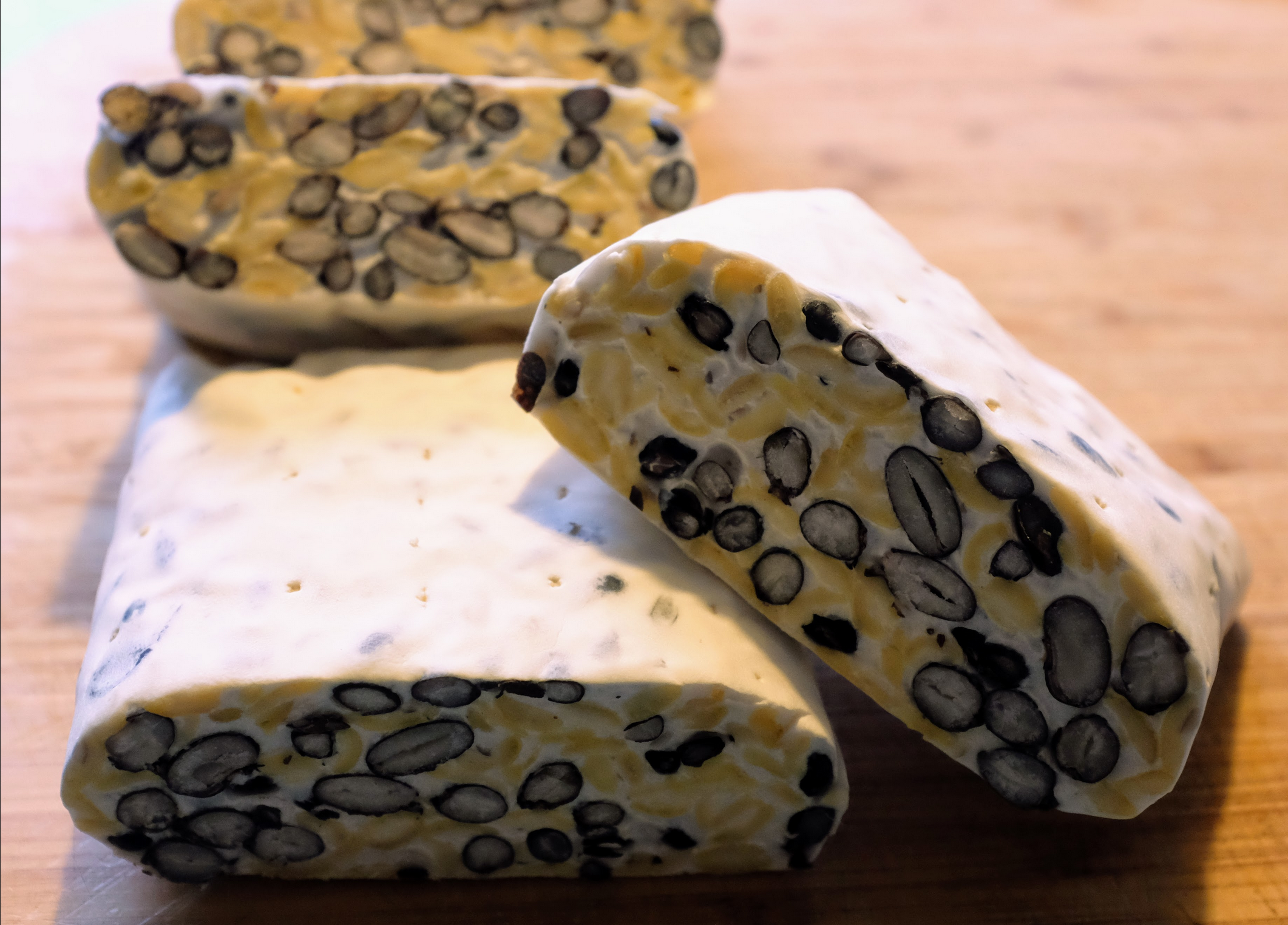
Black bean, Adzuki bean, fava bean
Fava beans: From Ville (the rounder kind, dehulled). 250g, soak o/n. Cook for 2.5 min. After cooking and drying: 430g (=1.7x). Add 1 Tbsp apple cider vinegar (4 Tbsp/kg). Add 1/2 tsp Raprima starter (2 tsp/kg).
Black beans: From Kville Indian Shop. 125g, soak o/n, cook for 45 min without dehulling. After cooking and drying: 243 (=1.8x). Add 1/2 Tbsp apple cider vinegar (4 Tbsp/kg). Add 1/4 tsp Raprima starter (2 tsp/kg).
Soy beans: From Kville Indian shop. 250g, soak o/n, roughly dehull part of it, cook for 45 min. After cooking and drying: 500 (=2x). Add 1 Tbsp apple cider vinegar (4 Tbsp/kg). Add 1/2 tsp Raprima starter (2 tsp/kg).
Adzuki beans: From rawfoods.se. 125g, soak o/n, cook for 8 min without dehulling. They lose a bit of the nice red colour, but are still pretty. After cooking and drying: 227 (=1.8x). Add 1/2 Tbsp apple cider vinegar (4 Tbsp/kg). Add 1/4 tsp Raprima starter (2 tsp/kg).
Put at 30°C in oven, start temperature of all bags: 27°C.
17h: Turn oven off for a while, since all cakes are at 35°C.
21h: Take soybeans out (36°C) to incubate a little longer on countertop. Leave the others (31-33°C) in the oven and turn on the oven again to 30°C.
26h: Harvest and heat treat in plastic bags wrapped in aluminium foil, for 45 min at 85°C.
Conclusion
This incubation was too rapid and the tempeh tasted a bit ripe.
Soy bean + oat residue (okara) tempeh (2022-01-27)
Soy beans: 250 g. Soak o/n, cook for 45 min, then drain and dry off a bit. Add 1 Tbsp apple cider vinegar (4 Tbsp/kg). Add 1/2 tsp Raprima starter (2 tsp/kg).
Oat residue (okara): Leftovers from oat milk production, about 30% moisture. Stored in freezer until use. Microwave for a few minutes to kill off microbes.
Soy bean + oat residue tempeh: Mix inoculated soy beans 1:1 with oat residue. Incubate in warm oven. Periodically turn oven on and off and open door, depending on temperature of tempeh blocks (thermometer sensor inside one block).
Conclusion:
Nice dense cake without much sporulation (only around air holes).
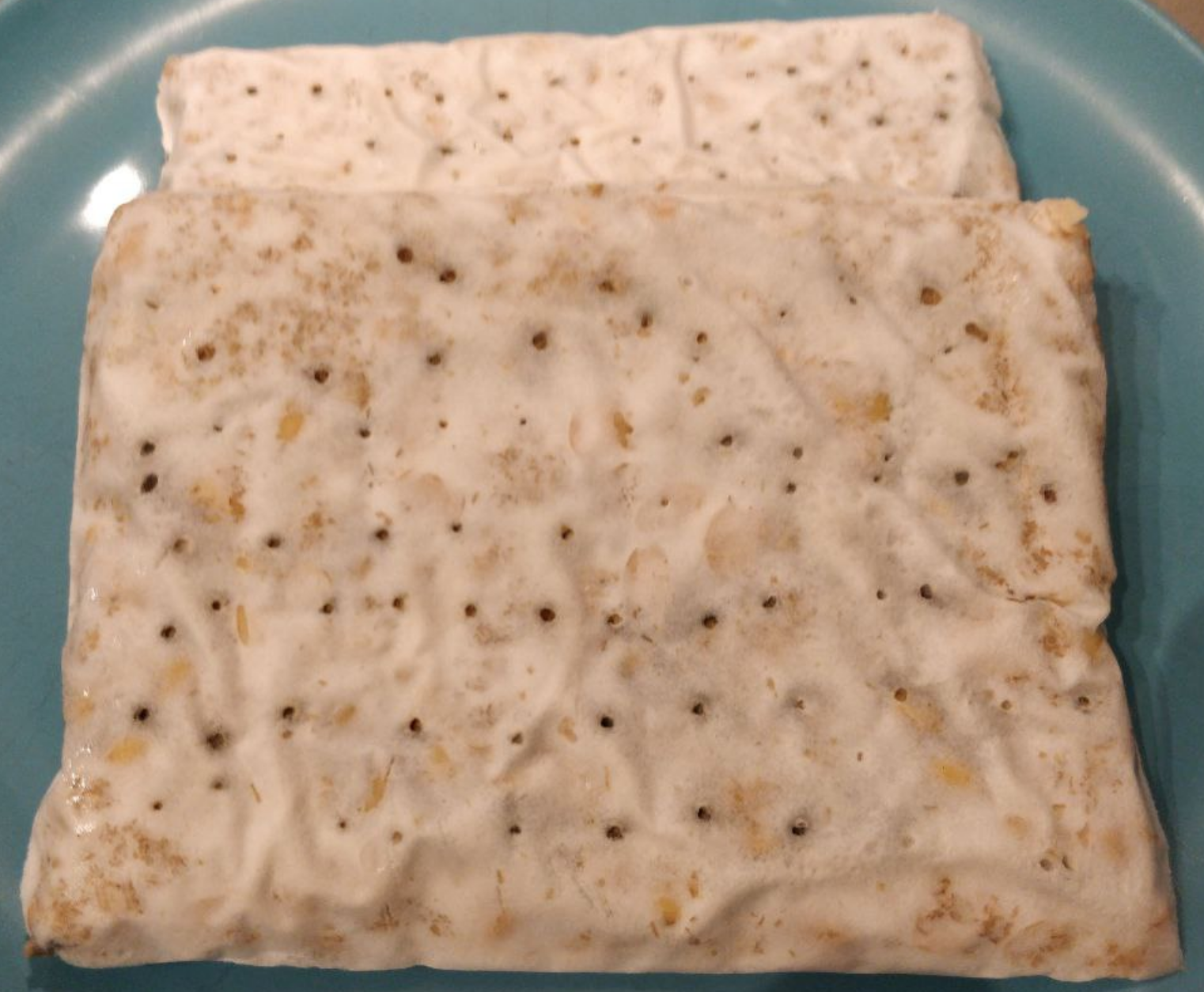
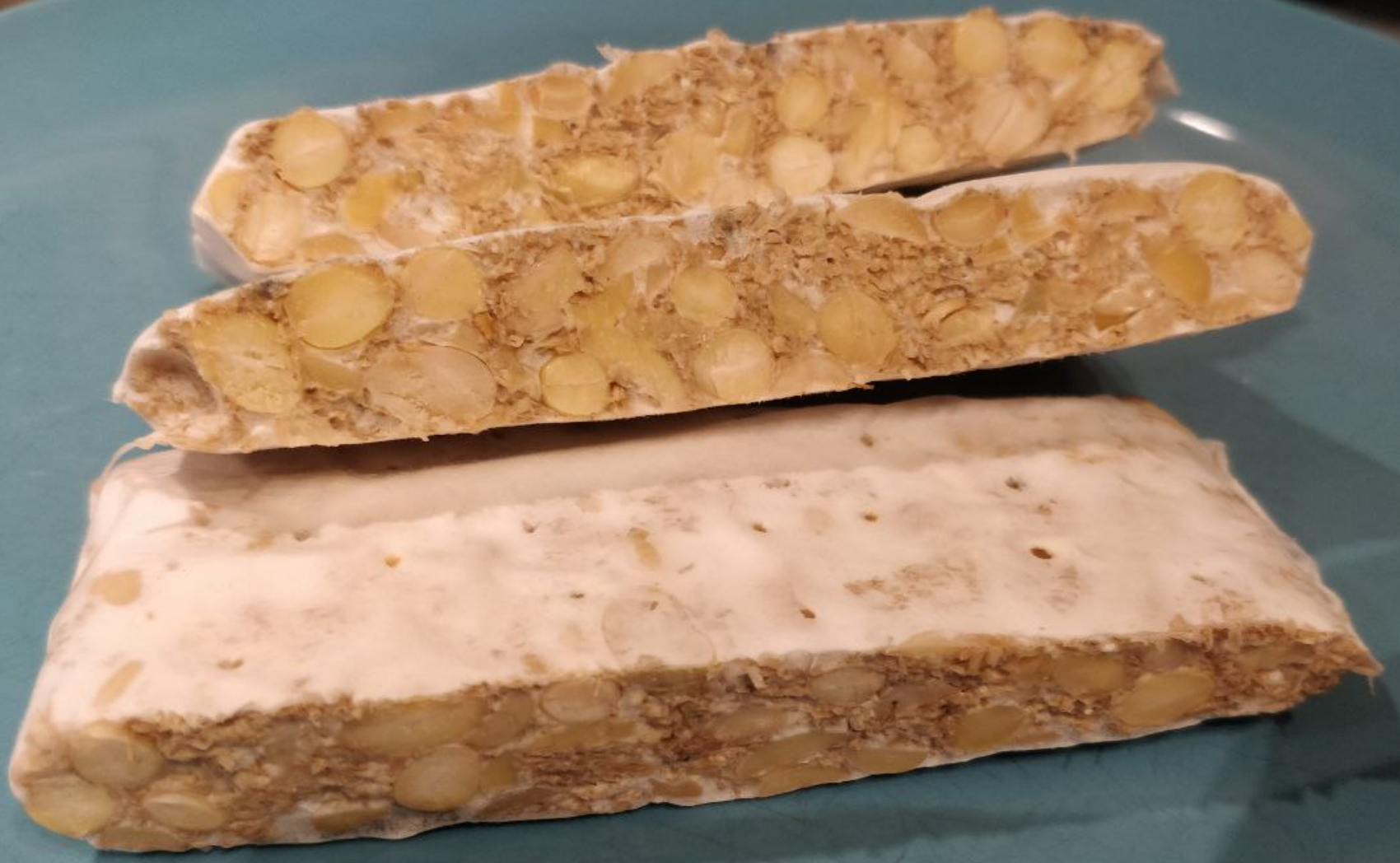
After frying in oil: Texture is not bad. Dense and a little chewy. Also a bit fibrous but not too unpleasantly. Maybe a bitter hint (when unflavoured). Pretty good when flavoured with soy sauce.
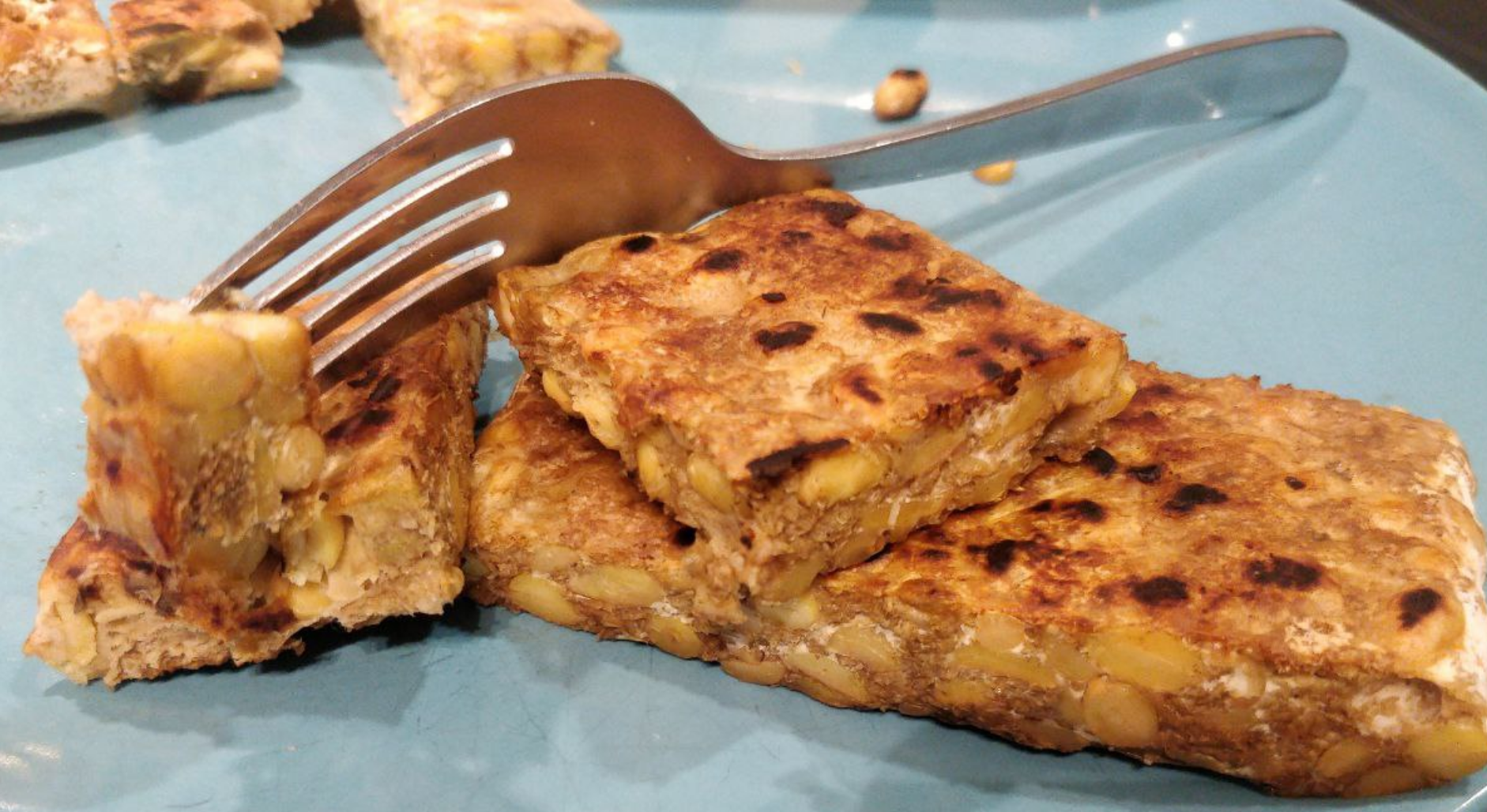
Moth bean + soy tempeh (2024-09-10)

Moth beans (brand: TRS, bought at IndoPak Malmö): 250 g. Soak for 8h, cook for 8 min, then add 1 Tbsp apple cider vinegar (4 Tbsp/kg), drain and dry off a bit. Add 1/4 tsp LUVI starter (1 tsp/kg).
Soy beans (brand: Heera, bought at IndoPak Malmö): 250 g. Soak 8h, leave skins, cook for 50 min, then add 1 Tbsp apple cider vinegar (4 Tbsp/kg), drain and dry off a bit. Add 1/4 tsp LUVI starter (1 tsp/kg).
Mix inoculated beans 1:1 and fill in bags.
Start: 22:00, 29C. Set heating mat to 32C, put in oven and cover with tea towel. 12h later, set to 31C. 12h later, set to 30C. 12h later, take off heating mat and let finish on the counter top (5h). End: 41h. Dense mycelium with no sporulation. Some white dots, mostly at bottom - probably larger particles of rice flour rather than some bacterial growth.
I sliced and fried one block, but it was quite crumbly and it was hard to keep together. Tasty though, especially flavoured with tamari and sesame oil. Kept the rest in the fridge for 2 more days to tighten up, then put in freezer for long-term storage.
Next time: Increase soy bean ratio to have the block hold together better. The moth beans have quite a tough outside and make the tempeh texture a bit looser.
Barley (+soy) tempeh (2024-xxxxx)
Pearl barley (brand: Heera, bought at IndoPak, Malmö): 250 g. Soak o/n, cook for 45 min, then drain and dry off well. Add 1 Tbsp apple cider vinegar (4 Tbsp/kg). Add 1/4 tsp LUVI starter (1 tsp/kg).
Make single barley or mix 20% barely with 80% soy beans.