Vietnamese pickled carrot and daikon
Shockey, “Fermented vegetables”, p150
Made 2022-03: Fermented carrot and parsley root
Made 2022-07-25: Vietnamese pickled carrot and daikon
- Brine: 1/4 cup (68 g) salt, 2.2 L water (= 3 g salt per 100 mL water) + 1/2 tablespoons sugar per L
- 450 g carrots, peeled and julienned
- 450 g daikon radish, peeled and julienned
- Optional: add a few lemon slices to the jar
- Optional: vine leaf
Add salt and sugar to water to prepare the brine.
Arrange the carrots and daikon in a jar, cover with the brine. Keep leftover brine in the fridge to fill up the jar if needed. Top off with vine leaf to keep the smaller vegetable chunks submerged.
Top with a weight to keep the vegetables down, cover loosely.
Set aside on a baking sheet to ferment, out of direct sunlight in a cool spot for 7-14 days. Top up with reserved brine if necessary.
When the brine starts to get cloudy, start tasting. They are ready when they are pleasingly sour and pickle-y tasting, without the strong acidity of vinegar.
Store in jars, with lids tightened, in the fridge. These will keep refrigerated for > 12 months.
Hungarian celeriac kraut
Shockey, “Fermented vegetables”, p158
Made 2022-03: Hungarian celeriac kraut
- 450 g celeriac, shredded
- 2-3 Hungarian wax peppers, thinly sliced
- 1/2 tablespoon caraway seeds
- 1/2 teaspoon ground paprika
- 1/2 teaspoon salt
In a large bowl, combine the celeriac with the salt and massage well, then taste. It should taste slightly salty without being overwhelming. Add more salt if necessary, until it’s to your liking. The celeriac will become limp and liquid may begin to pool.
Transfer a few handfuls at a time into a large jar, press down on each portion to remove air pockets. You should see some brine on top when you press. When the vessel is packed, leave a few centimers head space. Top with a weight and cover loosely.
Set aside on a baking sheet to ferment, out of direct sunlight in a cool spot for 5-10 days. Check daily to make sure the celeriac is submerged, pressing down as needed to bring the brine back to the surface.
Start tasting the kraut after 5 days. It’s ready when it’s pleasingly sour. The texture will be softer than cabbage-based kraut.
When the kraut is ready, store it in jars, with lids tightened, in the fridge. It will keep like that for >12 months.
Celeriac and carrot with caraway seeds
Inspired by Shockery, “Fermented vegetables”, p158
Made 2022-10-26: Celeriac and carrot with caraway seeds
- 300 g celeriac, peeled and chopped into roughly 2x2 cm pieces
- 250 g carrot, not pelled (just washed)
- 1 tsp caraway seeds
Brine: 3% salt brine (1L water with 3 g salt)
Slice carrots lengthwise twice to get quarter sticks. Then cut into roughly 3 cm long pieces. Mix with the celeriac pieces.
In a clean jar, place the caraway seeds at the bottom, then fill in the vegetable pieces. Fill up to the top with brine so everything is covered. Top with 2 clean wine leaves and push the vegetables down with a weight.
Place in a sun-protected place at room temperature and let ferment for 1-2 weeks.
Dill pickles
Made 2022-04-20: Dill pickles
Brussel sprouts with garlic and pepper corns
Made 2022-10-26: Brussel sprouts with garlic and pepper corns
Made 2022-12-24: Brussel sprouts with garlic and pepper corns
- 350 g Brussel sprouts, cleaned (outer 2-4 leaves removed)
- 1 big garlic cloves, peeld and whole
- 1 Tbsp black pepper corns
- 3 small green chilies, whole
Brine:
- 3.5% salt (1L + 35 g salt)
Cut Brussel sprouts in half or quarters, then fill into a clean jar with the rest of the ingredients. Top with enough brine to submerge everything. Cover with 2 clean wine leaves. Make sure that no pepper corns are floating on the surface (remove if necessary).
Leave in place out of sunlight at room temperature.
Fermented lotus root
Adapted recipe from Vietnamese pickled carrot and daikon
Made 2022-06-26: Did not work! No growth, despite the fact that I added an unpeeled carrot.The lotus roots were too sterile/preserved to allow any bacterial growth… Despite the fact that I added an unpeeled carrot.
- 3% Brine: 3 g salt per 100 mL water + 1 Tbsp sugar per 1L water
- 500 g fresh lotus root (slices and preserved in water, salt and ascorbic acid, bought at Asian Shop Helsingborg)
- 1 organic carrot, unpeeled but washed, cut in strips (mostly to inoculate with some lactic acid bacteria, since the lotus root is preseved and boiled)
Boil the lotus root slices in water for 15 min.
Add salt and sugar to water to prepare the brine.
Arrange the cooked and rinsed off lotus root slices as well as the carrot strips in a jar, cover with brine. Cover with grape leave and weigh down so everything is under brine.
When the brine starts to get cloudy, start tasting. They are ready when they are pleasingly sour and pickle-y tasting.
Fennel with mint and lemon
Inspired by https://farmsteady.com/blogs/field-guide/recipe-fennel-lemon-mint-kraut
Made 2022-07-25: Fennel with mint and lemon
- 1 fennel bulb
- 8 mint leaves
- 1 lemon, scrubbed and thinly sliced, seeds removed
- vine leaf (optional)
Basic 3% brine: 1000 mL water + 30 g salt
Cut fennel into large chunks. Arrange vegetables in jar and place the lemon slices and mint leaves around the outside. Cover with 1 vine leaf and weigh down so everything’s submerged. Leave at RT for a few days.
When the brine starts to get cloudy, start tasting. When sour enough, discard the lemon slices and mint leaves, transfer to jar with a lid and place in the fridge.
Fennel
Made 2023-07-22: Fennel
- 1 fennel bulb
- vine leaf
Basic 3% brine: 500 mL water + 15 g salt
UFO peaches
Inspired by The Noma Guide to Fermentation and https://www.tyrantfarms.com/how-to-make-lacto-fermented-fruit-with-recipes/
Made 2022-07-25: UFO_peaches
- 300 g of UFO peaches, cut into bite-sized chunks
- vine leaf (optional)
2% salt of total fruit weight = 6 g salt
Put the salt and fruit pieces in a jar and fill up with water until all fruits are covered. Stir with a chop stick. Cover with a vine leave, weigh down with a weight so everything is submerged. Leave standing at room temperature, taste every day until it has a pleasant taste.
Made 2026-06-28: UFO_peaches
- 520 g of UFO peaches, cut into bite-sized chunks
- 500 g water
- vine leaf
2.5% salt of total fruit + water weight = 2.5% of 1020 g = 25.5 g salt
Preserved lemons
Made 2023-01-21: Preserved lemons
- 3-4 lemons (organic, throroughly washed)
- salt
Cut the lemons into quarters that are still attached at the end. Sprinkle salt (generously!) on the exposed lemon, then squish it face down into a clean jar and press down to release some liquid. Salt the top of the lemon. Press some more. Proceed with the next lemon, salting and pressing on top of the other lemon.
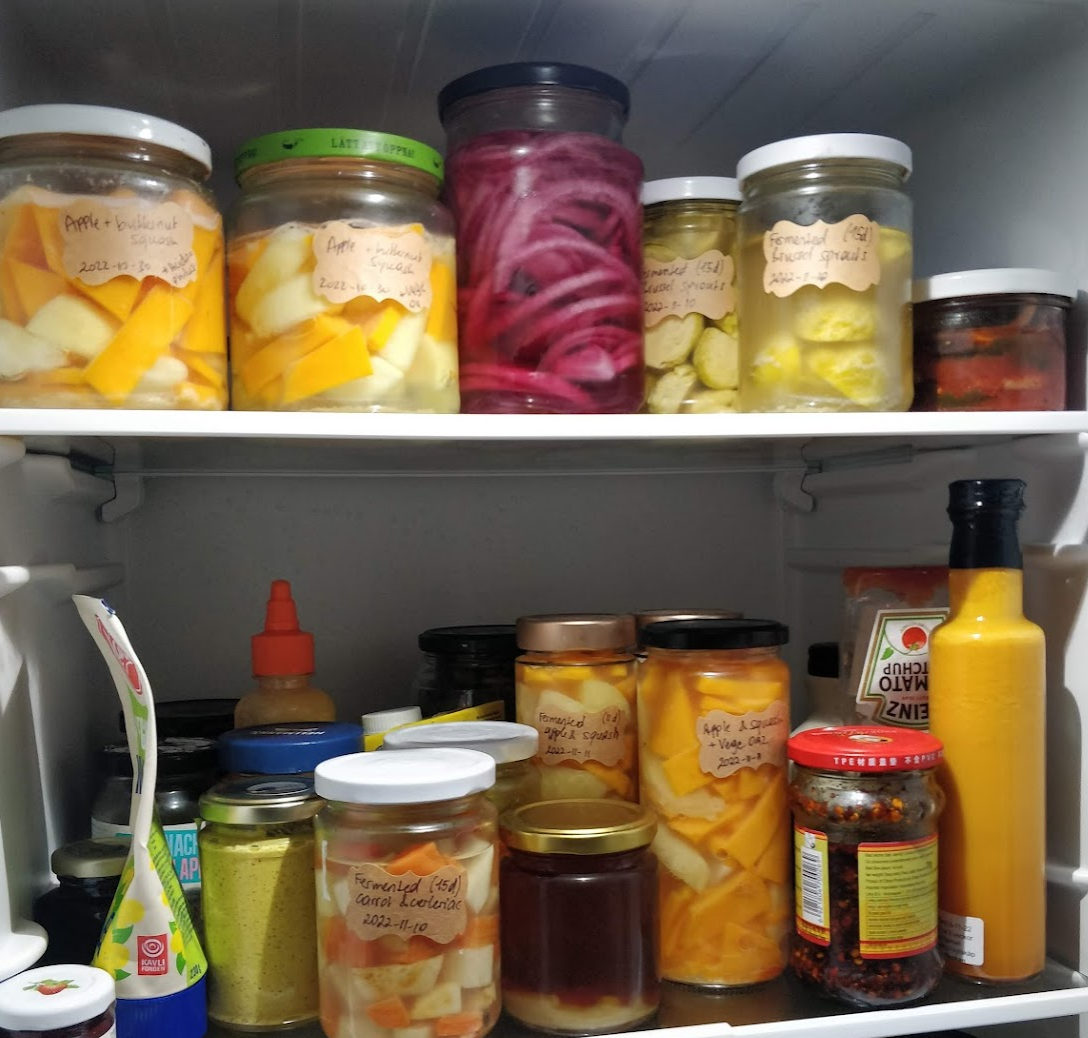
Fermented apples and butternut squash
Inspired by https://www.thekitchn.com/lacto-fermented-squash-and-apples-23102791
Made 2022-10-30: Fermented apple with butternut squash
- 600 g apples, peeled and cored, cut into bite-sized chunks
- 1 medium-sized butternut squash, peeled and de-seeded, cut into small, 0.5-cm thick slices
3% brine: 30 g salt + 1 L water
Cut the fruits and drop the apple pieces into the prepared brine as soon as they are cut to avoid browning. When everything is cut, fill into jars and pack tickly, cover with the brine, and weigh down with a weight so everything is nicely submerged. Leave at room temperature and start tasting when the liquid becomes cloudy.
Turkish peppers
Made 2022-07-25: Turkish peppers
- 500 g Turkish (or Hungarian) peppers
- vine leaf
Basic 3% vegetable brine: 1000 mL water + 30 g salt
Cut peppers into bite-sized chunks. Arrange vegetables in jar and fill up with brine until everything is covered. Top off with 1 vine leaf and weigh down so everything’s submerged. Leave at room temperature for a 7-14 days. When it has a nice pickel-y taste, it’s ready for eating (or storing in the fridge).
Fermented daikon radish 1
https://www.fermentingforfoodies.com/fermented-radishes-for-a-delicious-snack/
- Daikon radish
- Beetroot (optional)
- 2 cups (473 mL) of water + 2 tsp (12 g) of salt = 2.5 g salt per 100 mL water
Wash, peel and slice large daikon radish into 1 cm thick slices. Pack into a jar, together with a few slices of beetroot if you want a pink colour. NB: the beet root will make everything nicely pink, but also give everything an earthy, beety note.
Mix 2 cups of water with 2 tsp of salt. Fill up the jar with the vegetables and weigh down so the vegetables are under the liquid. With a loose lid, keep at RT for 3-5 days and observe fermentation. Taste regularly. When sour enough, store in the fridge.
Fermented daikon radish 2
Adapted from Shockey “Fermented vegetables”, p220 Made 2026-06-09: Alnarp vegetables ferments, Radish
- Daikon radish
- Salt - 1.3 g per 100 g daikon
Wash daikon, slice finely into thin slices. Combine with the salt and massage with your hands. Taste. The level of salt should be nice, but not overwhelming. Massage until some liquid comes out of the radish and it begins to pool. Transfer the radish with the liquid into a jar, tamper down with a tool or your hands to compact the radish. Put a weight on top and make sure that the liquid level is slightly above the vegetables. Leave for 1-2 weeks and start tasting from day 4. When sour enough, store in fridge.
Dilly kohlrabi-radish-turnip
Adapted from Kohlrabi kraut, Shockey “Fermented vegetable”, p190 Made 2026-06-09: Alnarp vegetables ferments, Dilly kohlrabi-radish-turnip
- Kohlrabi
- Radish
- Turnip
- Salt - 1.7 g per 100 g vegetables
Wash vegetables, peel the kohlrabi. Slice finely into thin slices or sticks. Combined with salt and massage with your hands. Taste. The level of salt should be nice, but not overwhelming. Massage until some liquid comes out of the radish and it begins to pool. Transfer the radish with the liquid into a jar, tamper down with a tool or your hands to compact the radish. Put a weight on top and make sure that the liquid level is slightly above the vegetables. Leave for 1-2 weeks and start tasting from day 4. When sour enough, store in fridge.
Japanese pickled cucumbers
https://okonomikitchen.com/japanese-pickled-cucumbers/, adapted
Very good and quick to make! Not fermented, but pickled. Tasty with rice or on sandwiches. Almost obscenely umami, because it contains so much soy sauce. You can also add bell pepper to the cucumber (or other similar vegetables).
- 500g cucumber
- 1 tsp salt
- 150g soy sauce
- 1 Tbsp rice vinegar
- 40g sugar
- 30g ginger
- 1 red chili pepper
Chop cucumber into 1 cm thick slices. Mix with salt in a bowl and let sit for 30 min.
Finely slice ginger and chili. Add to soy sauce, vinegar and sugar in a saucepan. Heat up and simmer until the sugar has dissolved. Pour out the cucumber water and press a bit, then pat the slices a bit dry with a paper towel. Add to the saucepan with the soy sauce mix. Let simmer for 5 min, then let cool down. Fill into a jar and store in the fridge. Consume within approx. 10 days.
Curtido Rojo
Shockey “Fermented vegetables”, p121
- 1/2 head of cabbage (red or green), finely sliced
- 1 beet, peeled and shredded
- 115 g green beans, sliced in 1 cm pieces
- 2 cloves garlic, minced
- 1 fresh jalapenos, seeded and minced
- 1/2 tablespoon cumin seed
- 1/2 tablespoon grated orange or lime zest
- 1/2 tablespoon dried oregano
- 1/4 teaspoon red chili flakes
- 1 tablespoons unrefined sea salt
- 2 bay leaves
- Optional: 1 carrot, thinly sliced
- Optional: 1 onion, thinly sliced
Massage the salt and spices into the cabbage and vegetables, like for Sauerkraut. When the brine has developed and is ready to pack, lay the bay leaves in the bottom of a approx. 2 L vessel, pack tightly.
Beet kvass
Shockey “Fermented vegetables”, p125
- 700 g beets, peeled
- 950 mL water
- 2 teaspoons salt
Chop the beets into 1 cm pieces and but them in a 2 L vessel. Add water to fill and mix in the salt. Cover loosely. Set aside on a baking sheet to ferment, out of direct sunlight, in a cool spot for 5-7 days, stirring daily.
Start tasting the liquid on day 5. If you want something more like a vinegar, ferment for 1 week longer.
Sauerkraut
Mama’s Sauerkraut (Tupperware)
Made 2021-12-13: Sauerkraut
- 10kg gehobeltes Kraut
- 80g Salz (= 8g/kg) = 0.8%
- 200g Milchzucker
- Kümmel, Wacholder
Gut mischen bis Saft entsteht. In Kübel drücken bis Saft darüber steht. Deckel regelmäßig lüften (1-14 Tage, RT). Nach 14 Tagen kühl stellen und fest verschließen. Saft sollte immer über Kraut stehen. Wenn notwendig mit Salzwasser (1L + 1 EL Salz) auffüllen.
Sauerkraut von Chefkoch.at
- 10kg Weißkraut
- 120 Salz (= 12g/kg) = 1.2%
- 20g Kümmel
- 10g Dillsamen
Fein hobeln, mit Salz vermischen, kneten bis Saft rauskommt. Gläser auskochen, Sauerkraut einfüllen, mit Frischhaltefolie abdecken. In Wanne stellen, 3-6 Tage in der Küche, dann im Keller. 14-21 Tage, dann Kühlschrank.
Mama’s Sauerkraut im Tontopf
- 10kg Weißkraut
- 50-100g Salz (= 5-10g/kg) = 0.5-1%
- Kümmel
Krautschnitzel und Salz schichten. Stampfen bis Saft übersteht, Topf mit sauberem Geschirrtuch abdecken. Gewichte drauf. Saft sollte in jedem Fall über Kraut stehen. Tuch, Deckel und Gewichte 1x pro Woche reinigen. Bei zu wenig Flüssigkeit einfach mit Salzwasser auffüllen. Kühl lagern, 4-6 Wochen.
Sauerkraut von OÖ Nachrichten
- 1 kg Weißkraut
- 8-15 g Salz (= 8-15 g/kg) = 0.8-1.5%
- 1 EL Kümmel
- 4-5 Wacholderbeeren
- 1-3 Weinblätter
- Krautblätter zum Abdecken
Kraut waschen, 1-2 große grüne Krautblätter zum Abdecken beiseite legen. Strunk herausschneiden, Kraut hobeln. In einer Schüsesel mit Salz und Gewürzen vermischen, gut durchkneten/stampfen. Handvoll für Handvoll in ein Glas füllen und gut zusammenpressen. Beim Drücken soll Lake sichtbar werden und über dem Kraut stehen. Das Kraut mit Krautblättern abdecken, beschweren, abdecken. 3-7 Tage bei Zimmertemperatur (18-23°C), dann 2 Wochen bei ca. 15°C fermentieren lassen. Anschließend am besten in den Keller (5-10°C) stellen. Nach 4-6 Wochen ist das Sauerkraut fertig.
https://www.ift.org/news-and-publications/food-technology-magazine/issues/2020/november/columns/food-safety-and-quality-innovations-in-vegetable-fermentations: CaCl2 as salt replacement, starter cultures and right conditions makes fermentations finish in 5 days.
Basic chili ferment (for hot sauce)
Inspired by https://farmsteady.com/blogs/field-guide/recipe-fermented-peach-hot-sauce and Shockey “Fiery Ferments” p107
Version 1
Made 2022-08-13: Fermented triple chili & peach sauce
- approx. 450 g chili peppers
- 1 whole white onion
- 3 big garlic cloves
- vine leaf
Basic 3% vegetable brine: 1000 mL water + 30 g salt
Deseed chili peppers (wear gloves! 😬) and cut into bite-sized chunks. Peel and cut onion into rough cubes. Peel garlic cloves.
Arrange vegetables in jar and fill up with brine until everything is covered. Top off with 1 vine leaf and weigh down so everything’s submerged. Leave at room temperature for a 7-14 days. When it has a nice pickel-y taste and the liquid is cloudy, it’s ready. Blend in blender to get sauce with the desired consistency. A bit of vinegar adds a nice flavour. If it’s too thick, you can add a bit of water. Adjust salt to taste. Optional: mix with fruit purré or fermented fruit to get a fruitier and slightly sweet condiment.
Fill into clean jars and keep in fridge for 2-12 months. Or heat up to boiling, simmer for several minutes and fill hot into sterilised bottles/jars to be able to keep at room temperature for months. Once opened, store in fridge.
Version 2
Made 2026-06-28: Fermented triple chili & peach sauce
- 350 g green Jalapenos
- 333 g red straight chili
- 225 g red Habaneros
- 1500 g water
- 2 big yellow onions
- 7 cloves of garlic
- 1 vine leaf
2.5% salt brine of weight vegetables + water = 2660 g total ⇒ 66.5 g salt
Instructions as for version 1.
Kimchi (vegan)
Recipe adapted from: https://www.seriouseats.com/homemade-vegan-kimchi-recipe
Made: 2022: Kimchi
- 1 large Chinese cabbage
- 1 small daikon radish
- 8 spring onions
- flaky sea salt (kosher salt)
- 8 garlic cloves
- 4 cm piece of ginger
- 1/2 cup gochugaru (Korean chili flakes)
- 2 Tbsp miso paste (white or red)
- 1 Tbsp sugar
- Wash cabbage, then remove trunk and cut the leaves into rough pieces (approx. 3x3 cm).
- Wash the daikon and cut into little sticks.
- Wash the spring onions, chop roughly and set aside.
- Place cabbage leaves, daikon and green parts of the spring onions into a large bowl. Sprinkle with 2 Tbsp flaky sea salt. Toss to combine and work in a bit with your hands. Cover with a plate or tea towel, then let sit at room temperature until cabbage is wilted (min. 1h, better up to 12h). The cabbage will release some liquid.
- Combine white parts of spring onion, minced garlic, finely chopped ginger, chili flakes, miso paste and sugar in a blender or food processor. Start pulsing to combine everything. Slowly add water to get to the right pasty consistency for it to blend properly (approx. 1 cup). Blend this past about 30 sec, scraping down the sides to not have too big chunks.
- Add the chili paste to the wilted cabbage and mix well with a spoon.
- Prepare glass jars by pouring boiling water into them and leaving to soak for a bit. Empty the jars and let cool down.
- Fill the cabbage-chili mixture into the jars, pressing down firmly with a spoon or chop stick to pack it tightly and not leave any air pockets. Make sure the top is covered with some of the liquid.
- Close jars and leave at room temperature for 24h. Then transfer to fridge and allow to ferment for at least 3 weeks before eating.
It will not develop much CO2, so it’s actually ok to close the jar tightly. I still air it from time to time during the first days and weeks, when I think about it.
It will last forever in the fridge and just get more sour and softer.
Green tomatoes
_Made: 2024-10-22: Green tomatoes
3% salt brine
- 10 green tomatoes
- 3 small red and yellow chilies
- some peppercorns
- Cut the green tomatoes in 6-8 wedges each.
- Slice the chilies into strips and remove seeds.
- Add peppercorns, submerge everything in brine, and weigh down.
- Ferment at RT for 10-14 days. Taste regularly to determine right acidity level.
- Then store in fridge in jars.
Quick pickles (with vinegar)
Technically not fermented, but still delicious!
Quick-pickled carrots & cucumbers
Adapted from: https://livelytable.com/asian-style-quick-pickled-carrots/
- 2 carrots, cut into matchsticks
- 1/2 cucumber or several baby cucumbers, cut into matchsticks
- ¼ cup rice vinegar
- ½ cup hot water
- ½ tsp sugar
- 1 tsp salt
- optional: fresh ginger slices
- Pack vegetables tightly into a freshly cleaned and sterilised jar.
- Optional: Add a few ginger slices.
- Mix water, vinegar, salt and sugar. Stir to dissolve.
- Pour the mix over the vegetables to cover them completely.
- Let cool down and then place in fridge (or for immediate use, let soak for min. 30 min). Lasts about 2 weeks in the fridge.
Japanese-pickled cucumbers with sesame oil
Adapted from: https://thelemonbowl.com/japanese-quick-pickled-cucumbers/
- 1 cucumber, halved and thinly sliced
- 2 spring onions, diced
- ¼ cup rice vinegar
- 2 Tbsp light soy sauce
- 1 tsp sugar
- 1 tsp sesame oil
- Optional: 1 tsp chili paste
- Optional garnish: black roasted sesame seeds
- In a medium bowl, whisk together vinegar, soy, sugar, sesame oil and chili paste until everything is dissolved.
- Add cucumbers and scallions to bowl and toss well. Let sit at room temperature for 15 minutes or longer before serving.
- Garnish with black roasted sesame seeds.
- If made in advance, add some water to the liquid, pour everything over the cucumbers in a cleaned and sterilised jar and store in the fridge (for up to 2 weeks).